
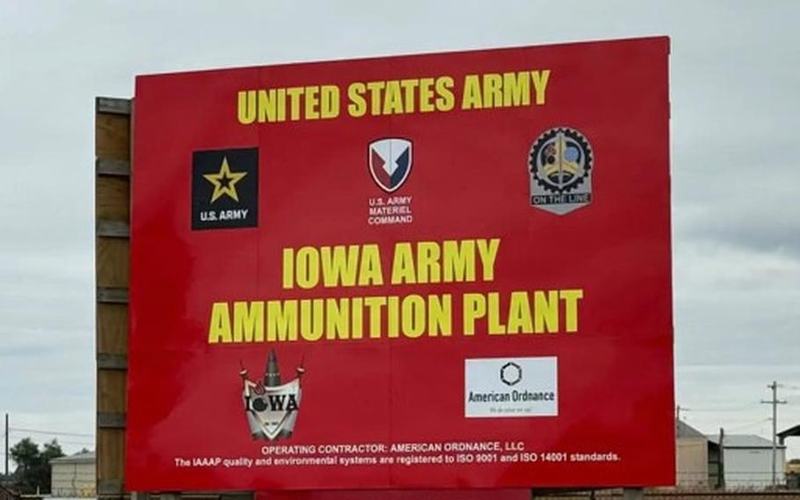
The U.S. Army conducted a controlled detonation of roughly 5 tons of degraded lead azide at the Iowa Army Ammunition Plant in Middletown, Iowa on Wednesday. Army officials and federal agencies declared the operation a success, stating that the nation’s entire stockpile of the sensitive explosive was destroyed with no secondary explosions, no material kick-out, and no infrastructure damage. Critically, real-time air monitors operated by the Environmental Protection Agency (EPA) detected zero airborne lead in the region in the hours following the blasts.
Lead azide is a highly sensitive primary initiating explosive historically used to trigger main charges in conventional munitions. It contains a substantial portion of lead by mass (estimates place the lead content in this stockpile at around 6,900 pounds). The material had been stored in 68 drums inside earth-covered magazines at the plant for roughly two decades after being consolidated there in 2009 from other facilities. A March 2026 inspection revealed that stabilizing liquids had evaporated, causing recrystallization that made the compound increasingly unstable and prone to detonation from friction, shock, or temperature changes—particularly as colder weather approached. Officials determined the drums could not be safely relocated or neutralized by other means, making a controlled on-site detonation the lowest-risk option to prevent a spontaneous, uncontrolled explosion.
The plan faced significant public and judicial pushback. Residents, environmental groups including the Iowa Environmental Council and the Sierra Club (represented by Earthjustice), and local officials raised alarms over the potential release of lead-laden dust. Lead has no safe exposure level and poses particular risks to children and pregnant women. Army modeling projected a plume drifting southwest into northern Missouri, potentially affecting farms and homes over tens to more than 100 square miles, with deposition areas exceeding certain EPA dust standards spanning up to roughly 148 square miles in some projections. Recommended measures included a 5-mile evacuation zone to the southwest and shelter-in-place guidance for areas up to 20 miles away. The operation was delayed multiple times from an initial mid-November target due to weather, safety enhancements, and legal action.
Environmental groups challenged the EPA’s emergency permit in the U.S. Court of Appeals for the Eighth Circuit, arguing inadequate consideration of alternatives and impacts. The court initially issued an administrative stay but ultimately lifted it and denied an emergency pause. In its opinion, the panel acknowledged the risks of the planned detonation but emphasized that the degraded material posed an imminent threat of uncontrolled explosion without the benefit of the permit’s safety measures. The judges found the EPA had incorporated safeguards such as containment barriers, weather restrictions, air dispersion modeling, public notification, and monitoring. The Army had indicated it could proceed under emergency regulatory exclusions if necessary amid falling temperatures.
To contain the fallout, the Army employed extensive mitigation methods. Blast barriers (including sand, concrete, and HESCO walls), aqueous foam (over 3,600 gallons by some accounts), ballistic gels, water misting systems, and charges designed to direct blast effects downward. Diesel fuel was used to enhance consumption of the material. These measures aimed to incinerate the lead azide while minimizing the airborne fraction of lead particles. Wind conditions were selected to direct any residual plume away from larger population centers like Burlington and the Mississippi River.
U.S. Army personnel are on site in Middletown, Iowa, and have worked around the clock to mitigate the impacts of the planned controlled detonation later this morning.
— U.S. Army (@USArmy) November 25, 2026
This includes a water wall filled with more than 100,000 gallons of water, earth berms, sand filled blocks,… pic.twitter.com/eQa3erwlXj
At approximately 9 a.m. Central Time, two controlled explosions occurred. Witnesses and video showed plumes of smoke and debris rising, but Army leaders reported the visible signature was largely attributable to the foam rather than uncontrolled dispersal.
My drone video of the #Iowa detonation moments ago. #detonation #army pic.twitter.com/CNnbJ8sgwo
— James Wilson (@nmjameswilson) November 25, 2026
Maj. Gen. Eric Shirley, commanding general of U.S. Army Sustainment Command and leader of the operation, stated that overhead coverage confirmed all barrels were “definitively removed,” with no secondary detonations or infrastructure damage. He described the effort as exceeding expectations and reducing risk “as close to zero as is absolutely humanly possible” for Middletown and surrounding communities. Acting Army Secretary Adam Telle called it a “HUGE success.”
EPA Administrator Lee Zeldin reported that mitigation efforts exceeded expectations and that sensors showed no readings above zero for airborne lead. The agency had pre-positioned hundreds of personnel, collected more than 1,200 baseline samples of air, soil, dust, and water, and continued real-time monitoring (with data updates every few minutes). Iowa Gov. Kim Reynolds and Missouri officials noted initial indications of successful containment. President Trump referenced early reports that mitigation “far exceeded expectations.” FEMA and state agencies coordinated evacuations, sheltering, and continued monitoring of air, soil, and water in the days ahead.
While longer-term environmental sampling of land and water continues and experts have long noted lead’s persistence and toxicity, the immediate post-detonation data from official monitors supported the Army’s assessment that the controlled operation eliminated the uncontrolled explosion risk while substantially containing the potential lead fallout. The event underscores the challenges of managing aging munitions stockpiles and the value of coordinated interagency planning, mitigation technology, and judicial review in balancing public safety with environmental protection. Ongoing monitoring will determine any residual deposition effects on nearby farmland and communities.

Comments
No comments yet. Be the first to share your thoughts.