
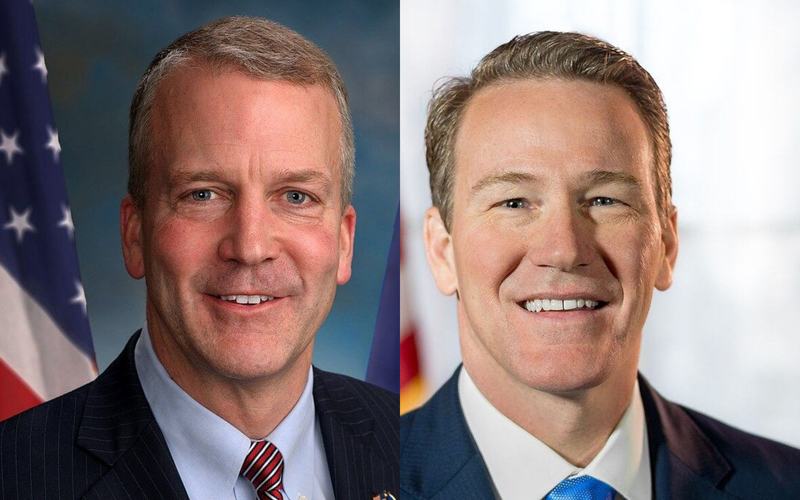
A top executive at one of the Republican Party’s largest consulting firms served as treasurer for super PACs that spent more than $9.9 million targeting two GOP senators who ultimately lost their 2026 reelection bids. Federal election records identify Thomas Datwyler—listed on Axiom Strategies’ website as CEO of its AxCapital division—as treasurer and custodian of records for three super PACs registered between March and October 2026. Those groups reported spending that targeted Ohio Sen. Jon Husted and Alaska Sen. Dan Sullivan, both of whom lost to Democratic challengers amid a broader Democratic wave in the midterms. Husted, who had been appointed to fill the seat vacated by JD Vance, fell to former Sen. Sherrod Brown. Sullivan lost to former Rep. Mary Peltola, flipping Alaska’s seat for the first time in nearly two decades and helping Democrats secure a Senate majority.
Axiom Strategies, founded by Jeff Roe, who managed Ted Cruz’s 2016 presidential campaign, is widely regarded as the GOP’s biggest consulting operation, with deep ties to Cruz and other prominent Republicans. The situation is exceedingly rare, if not unprecedented, for an executive at a major firm to work for groups seeking to defeat senators from the firm’s own party in a general election.
The three groups—Right for Alaska, Alaska Values PAC, and Buckeye Freedom PAC—boosted lesser-known or fringe candidates while attacking the incumbents from the right. Right for Alaska spent nearly $2.4 million through September 30 targeting Sullivan and supporting long-shot alternatives, including during the primary. Alaska Values PAC reported at least $3.75 million in spending that attacked Sullivan and boosted other candidates in the general election. In Ohio, Buckeye Freedom PAC spent more than $3.8 million attacking Husted and promoting Libertarian candidate William “Bill” Redpath, while also sponsoring a website that attacked the senator’s record. The ads accused Sullivan of supporting gender-transition surgeries for children and Husted of backing gun-control measures.
In Alaska, some messaging portrayed Sullivan as insufficiently conservative or too closely aligned with Sen. Lisa Murkowski. The groups promoted candidates such as Gerald Heikes and a same-name challenger, Daniel J. Sullivan, a retired teacher—a tactic that drew separate scrutiny over potential voter confusion. One of the Alaska groups, Right for Alaska, received $990,000 from the Sixteen Thirty Fund, a major liberal organization that has previously been funded by groups tied to Democratic megadonor George Soros. Funding sources for the other PACs were less transparent, with filings showing payments to little-known LLCs registered in Wyoming and Delaware.
Earlier reporting had already detailed Datwyler-linked PACs spending millions in the final weeks to attack the incumbents from the right and elevate long-shot candidates, following a similar playbook used in the Alaska primary. Redpath said he had never met Datwyler and was unaware of the source of the supportive spending.
Axiom founder Jeff Roe claimed to have learned of Datwyler’s involvement from a lawyer on October 30 and demanded his resignation that day. Datwyler resigned immediately. Axiom said it would complete unwinding its relationship with him by December 31 and removed him from the company website. An Axiom spokesperson stated that the firm is a Republican organization whose sole purpose is to defeat Democrats, that its companies did zero work against the Republican nominees for U.S. Senate in Ohio and Alaska, and that it has zero connection to any of those PACs’ vendors. Sources described Datwyler as having been recruited by an outside consultant to set up the groups and as someone who accepted clients without always closely scrutinizing their objectives. Datwyler has not released a comment at this time.
Datwyler is a veteran Republican campaign-finance consultant based in Wisconsin. He has served as treasurer for hundreds of political committees and has long been associated with AxCapital and Axiom. He has faced a string of campaign-finance complaints, investigations, and fines across multiple states and at the federal level, including matters linked to former Rep. George Santos, a Mississippi criminal investigation, FEC penalties, and complaints in places such as Nevada, Tennessee, and Alabama. Critics have accused him of operating at industrial scale with limited scrutiny of clients, while supporters have described the volume of his work as a compliance strength.
The 2026 midterms produced significant Democratic gains, including in states that Donald Trump carried comfortably in 2024. The Ohio and Alaska races were high-profile and expensive, with outside groups pouring large sums into both. Cruz campaigned for Sullivan in Alaska in October. Broader national dynamics—economic concerns, Trump’s standing, and a Democratic backlash—shaped the environment in which the Datwyler-linked PACs operated. Their approach of attacking Republican incumbents from the right while elevating minor candidates fits a known tactic of attempting to peel off conservative votes or create ballot confusion, though proving causation in any single race is difficult.
Tensions inside Republican political infrastructure has sparked discussions in political circles over the line between independent outside spending and a firm’s own brand, as well as the opacity of dark-money and LLC-funded activity, and the risks for a major consulting operation when a senior executive’s outside work collides with the party’s electoral interests. Axiom has emphasized that it did no work against the nominees and is severing ties with Datwyler. The full picture of who funded the groups and how much influence they exerted will depend on further disclosures.

Comments
No comments yet. Be the first to share your thoughts.