
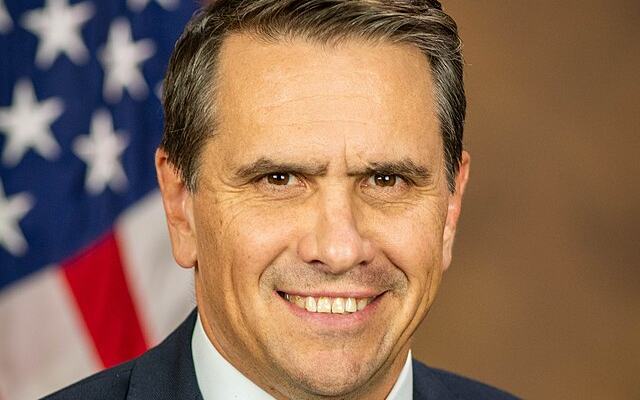
Attorney General Todd Blanche defended the Justice Department’s lawsuit over Alaska’s upcoming Senate election on Sunday, arguing that the state may be violating federal law by allowing two candidates with similar names to appear on the ballot.
Speaking on CNN’s “State of the Union,” Blanche said the lawsuit concerns potential voter confusion involving Republican Sen. Dan S. Sullivan and challenger Daniel J. Sullivan Jr. Democrat Mary Peltola is also running for the seat.
“We’re not saying that the federal government is going to decide who the next senator from Alaska is,” Blanche said, rejecting suggestions that the Trump administration is seeking to take control of the state’s election.
The Justice Department filed the lawsuit Thursday, challenging the state’s decision to allow Daniel J. Sullivan Jr. to remain on the ballot. Republicans argue that his name could confuse voters and divert votes from the incumbent.
The Alaska Supreme Court ruled in June that the challenger could remain on the ballot. Blanche argued that the state court considered Alaska law, while the federal lawsuit raises separate questions about compliance with federal law and the Constitution.
“So, the question is whether Alaska, by allowing this to happen, is violating the law and the federal law and the Constitution by allowing confusion on the ballot,” Blanche said.
Blanche accused the second Sullivan of running to confuse voters, citing statements he attributed to Alaska’s elections director. However, when asked what crime had been committed, the attorney general did not identify a specific criminal offense.
“There could be a crime, but the real wrong here is that Alaskans are going to be confused and will not have their vote heard,” he said.
Republican Sen. Lisa Murkowski of Alaska has criticized the lawsuit, arguing that state officials already addressed the issue by distinguishing the candidates on the ballot, including identifying the incumbent.
Blanche said the Justice Department wants Alaska officials and courts to examine whether voter confusion affected the election’s outcome. He pointed to the state’s ranked-choice voting system as a possible source of evidence, but did not explain how officials would distinguish an accidental selection from an intentional vote.
The complaint seeks to prevent certification of results potentially affected by voter confusion. Blanche said the request would apply if officials determine that the law had been violated.
The attorney general also declined to say whether President Donald Trump personally directed the lawsuit after publicly taking credit for the action.
“I will never talk about any communications I have with the president of the United States,” Blanche said.
Blanche said attorneys in the Justice Department’s Civil Rights Division had identified a federal legal basis for intervening and had been examining the issue for months. He added that the department had hoped the Alaska Supreme Court would publish an explanation of its earlier ruling before federal officials acted, but that explanation had not yet been issued.
Asked whether the Justice Department would bring the same challenge if two Democratic candidates shared a name, Blanche responded, “Absolutely, of course.”
He rejected suggestions that the lawsuit was intended to establish a way for Trump to overturn an unfavorable election result.
“But I do think it’s important for the American people to understand that we are not, President Trump is not trying to take over a state election in any way, shape, or form,” Blanche said.

Comments
No comments yet. Be the first to share your thoughts.