
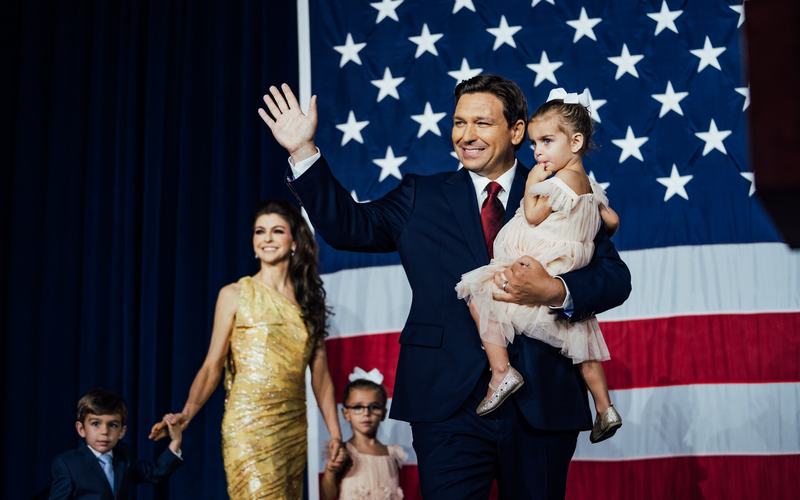
Florida Gov. Ron DeSantis on Friday flatly rejected a Washington Post report claiming he is preparing to run for the Republican presidential nomination in 2028, calling the story a fabrication designed to generate clicks.
The Washington Post article, published earlier on Friday, cited three people that it alleged had been briefed on DeSantis' plans for a 2028 run. The article claimed that DeSantis had reached out to at least one national political consultant about working on a campaign and that his federal super PAC sent a fundraising text this week. The report tied the rumored bid to Florida's performance in this week's midterm elections, where the state remained one of the few to hold its ground for the GOP amid sweeping Democratic gains. Florida Republicans retained key statewide offices this week, including Rep. Byron Donalds holding the governorship and Ashley Moody holding her U.S. Senate seat, even as GOP candidates in other traditionally red strongholds floundered.
DeSantis' denial of the report was direct and categorical. He posted on X saying the media outlet was "fabricating this out of whole cloth." He stated he has not reached out to anybody about running and called the report a "pathetic attempt to garner clicks" that conveniently relies on unidentified sources.
The Washington Post is fabricating this out of whole cloth. I have not reached out to anybody about running for anything. Just another pathetic attempt to garner clicks.
— Ron DeSantis (@RonDeSantis) November 6, 2026
Using anonymous sources of course! pic.twitter.com/v9PtX6HgSj
This is not the first time the governor has criticized media outlets, particularly in their use of anonymous or unnamed sources in their reporting.
In 2023, DeSantis backed Florida legislation that would have made it easier for an affected party to sue for defamation by treating the use of anonymous sources as creating a presumption of malice—the high standard public figures must meet under New York Times v. Sullivan. He argued that “particularly corporate media outlets have relied on anonymous sources to smear people” and that the practice is “fundamentally wrong.” The legislation did not advance.
He developed the argument further at a February 2023 roundtable on media defamation. DeSantis said legacy outlets had “embraced the practice of laundering character attacks through the use of anonymous sources,” allowing them to damage reputations without giving targets a practical way to respond. He pointed to the Russia collusion coverage as a leading example, describing it as largely based on anonymous sources and eventually debunked, yet repeated for years. He contrasted this with older journalistic norms, noting that using unnamed sources to attack someone’s character “would have been a total no-no.”
After the legislation stalled, DeSantis returned to the subject in May 2023. He said the rise of the anonymous source lets outlets “recycle gossip” or push a “pre-cooked narrative that they don’t have the goods for,” wrapping it in anonymity so they do not have to prove it to readers. He argued this erodes public trust, and while he allowed limited exceptions for “real serious malfeasance in government,” he said journalists should not use anonymity “to smear somebody.”
These positions track with his response to the current Washington Post report, which rests on three people “briefed on his plans” and at least one person “close to him,” all speaking anonymously about alleged outreach and fundraising activity.
DeSantis previously ran for the 2024 GOP nomination, finishing a distant second to Donald Trump in the Iowa caucuses before suspending his campaign and endorsing Trump. As a term-limited governor whose current term ends in January 2027, he has in recent months kept the door open on a future bid in public comments, including at the Milken Institute Global Conference earlier this year, where he pointed to Florida’s economic growth, voter registration shifts, and his age as leaving “a lot of runway.”
Analysts and party officials have pointed to the roughly 1.5 million-voter registration advantage Republicans built under the tenure of the DeSantis administration as a decisive factor that helped the state withstand a national environment that proved far more punishing elsewhere. DeSantis himself described Florida as the place that “held the line,” noting it as one of the few major conservative bastions to limit Democratic advances. That record of policy continuity on education, regulation, and pandemic-era governance provided a measurable foundation that kept the state competitive for Republicans when other red strongholds did not.
DeSantis himself pointed out that, after crushing GOP losses in the gubernatorial races in Texas, Ohio and Georgia, "there will be only one state of the top ten most populous states with a Republican governor: Florida."
With the loss of governors races in Texas, Ohio and Georgia, there will be only one state of the top ten most populous states with a Republican governor:
— Ron DeSantis (@RonDeSantis) November 4, 2026
Florida.
Florida stands as a bright spot for the Republican Party after sweeping losses in the midterms. Whether those results create a viable 2028 opening remains speculative. For now, DeSantis is publicly rejecting the premise that he is actively preparing another White House run and framing the Washington Post’s account as the latest example of a familiar media pattern: anonymous sourcing used to advance a narrative rather than to document verifiable actions.

Comments
No comments yet. Be the first to share your thoughts.