
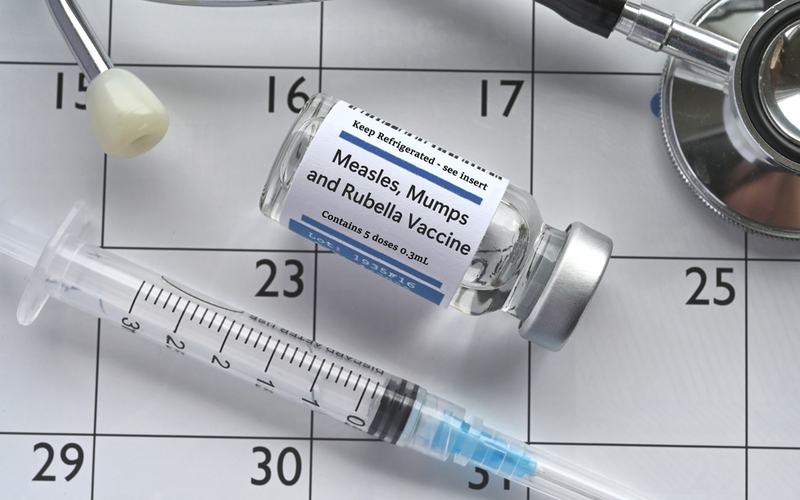
The United States is no longer considered to have eliminated measles, as outbreaks continue to spread across the country and raise new concerns about immunity among adults vaccinated decades ago.
The Pan American Health Organization announced Nov. 17 that the country had lost the status it held since 2000. An independent panel determined that measles had circulated continuously in the United States for more than a year, exceeding the threshold for maintaining elimination status.
The outbreak, which began in a Mennonite community in Texas in early 2025, has contributed to more than 5,800 reported cases and 12 deaths this year. Adults account for more than 40% of infections, according to The New York Times. Measles has also returned to sustained transmission in Mexico and Bolivia, while Canada lost its elimination status last year.
Against that backdrop, infectious disease specialists are advising some adults born before 1989 to consider another measles vaccine dose. Many in that generation received only one shot during childhood. All seven doctors interviewed by the Times said an additional dose could be worth considering for many people in that age group.
Dr. Brenda Tesini, an infectious disease physician at the University of Rochester, said the changing circumstances warrant a fresh look at protection.
"I think it's a different ballgame now," Tesini told the newspaper.
The Centers for Disease Control and Prevention currently considers one documented dose adequate for most adults who face a low risk of exposure. Two doses are recommended for certain groups, including health care workers, international travelers and college students. The CDC estimates that one dose is 93% effective against measles, while two doses provide about 97% effectiveness.
Some doctors believe those recommendations may not fully address the risks facing adults whose vaccinations occurred many years ago. Dr. Camille Kotton of Massachusetts General Hospital, a former member of the CDC's vaccine advisory committee, encouraged people uncertain about their immunity to consider another dose.
"it's a good time to boost for anybody who's not sure" of their risk, Kotton told the Times.
Kotton warned that commercially available antibody tests may not reliably establish whether someone is protected. Doctors also point to age, certain illnesses and medications as factors that can diminish the immune response generated by a childhood vaccination.
Dr. Pushpa Narayanaswami, a neurologist at Harvard Medical School and Beth Israel Deaconess Medical Center, said the protection from a single dose may not remain the same as a person grows older.
"The protection afforded by the one dose at 30 years is not likely to be the same protection afforded by the one dose at 63 or 73 or 83 years," Narayanaswami told the newspaper.
Vaccination history is particularly important for people who received shots during 1963 through 1967, when an inactivated measles vaccine was used. The CDC recommends revaccination for those who received that version or cannot confirm which vaccine they received. People with documentation of receiving the live vaccine during that period do not automatically need another dose.
Adults born before 1957 are generally presumed immune because measles was widespread before vaccines became available. Health care workers may require additional considerations.
The vaccine contains a weakened live virus, making it unsuitable for pregnant women and people with severely weakened immune systems. Those who cannot receive it depend in part on the immunity of people around them to reduce the likelihood of exposure.
The Times reported that the CDC's vaccine advisory committee has not met since December of last year following a federal court ruling.

Comments
No comments yet. Be the first to share your thoughts.