
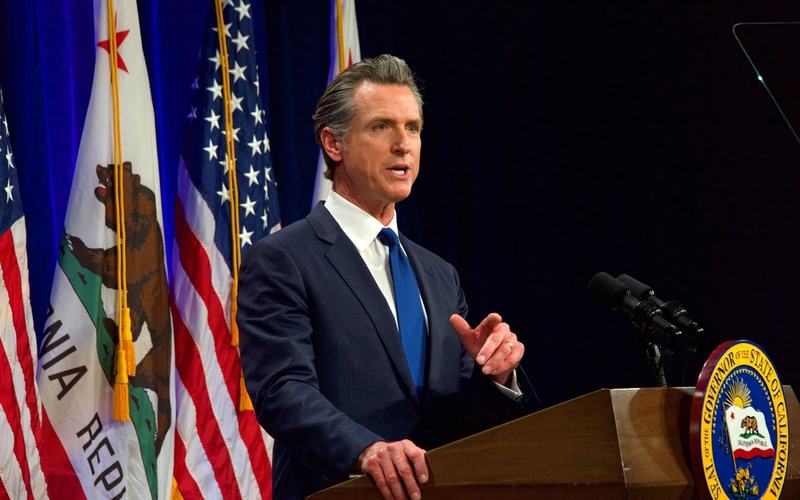
President Donald Trump said Monday that the Justice Department is working to reverse California Gov. Gavin Newsom’s plan to commute the death sentences of 548 convicted murderers, escalating the federal administration’s opposition to the governor’s sweeping clemency action.
Trump announced the effort during an appearance at Justice Department headquarters in Washington, where relatives of murder victims joined him to condemn Newsom’s decision. The president did not explain what legal mechanism federal authorities intend to use or how the department could challenge a governor’s clemency power.
Newsom, a Democrat who has been discussed as a potential 2028 presidential candidate, announced the proposed commutations Nov. 5. The plan would remove every death sentence in California and replace the sentences with life imprisonment without the possibility of parole. The governor has argued that capital punishment is costly, unfairly administered and carries the risk of executing an innocent person.
The president’s announcement came as victims’ families described the impact of the crimes committed by those on death row. Sandy Friend, whose 8-year-old son, Michael Lyons, was abducted and murdered in 1996, challenged Newsom’s decision at the Justice Department event. Robert Boyd Rhoades, convicted of killing Lyons, was sentenced to death in 1999.
The White House accused Newsom of disregarding victims and their families. Spokeswoman Lauren Bis said the governor was refusing to carry out justice for those affected by the murders.
Newsom defended the plan Monday, emphasizing that the prisoners would remain incarcerated for life. His office also argued that the commutations would not erase restitution obligations or allow any of the inmates to be released.
The proposal is already facing a legal challenge in California. District attorneys from 29 counties, joined by victims’ advocates, have petitioned the California Supreme Court to block the commutations, arguing that Newsom failed to provide victims and prosecutors an opportunity to be heard before announcing the decision.
The petitioners maintain that state law requires notification when a condemned prisoner seeks clemency. Newsom’s office argues those provisions do not apply because the governor initiated the commutations himself rather than acting on individual applications from prisoners.
A separate constitutional requirement could affect hundreds of cases. The California Supreme Court must review 382 of the proposed commutations involving prisoners with multiple felony convictions. At least four of the court’s seven justices must recommend clemency in those cases before Newsom can proceed.
None of the 548 commutations have taken effect, according to California’s Habeas Corpus Resource Center.
Newsom has opposed capital punishment for years. In 2019, he imposed a moratorium on executions and ordered the execution chamber at San Quentin State Prison dismantled. California has not carried out an execution since 2006, though courts have continued to sentence defendants to death.
Trump has taken the opposite approach, making expanded use of capital punishment a priority of his administration. After returning to office in January 2025, he directed the Justice Department to pursue death sentences for the most serious federal crimes and encourage their use where permitted by law. Attorney General Todd Blanche reiterated the administration’s support for capital punishment during Monday’s event.
Newsom responded by criticizing Trump’s use of presidential clemency, accusing the president of granting pardons to political allies and wealthy supporters. His office said Trump should explain to victims why his administration has used the pardon power to benefit convicted criminals.

Comments
No comments yet. Be the first to share your thoughts.