
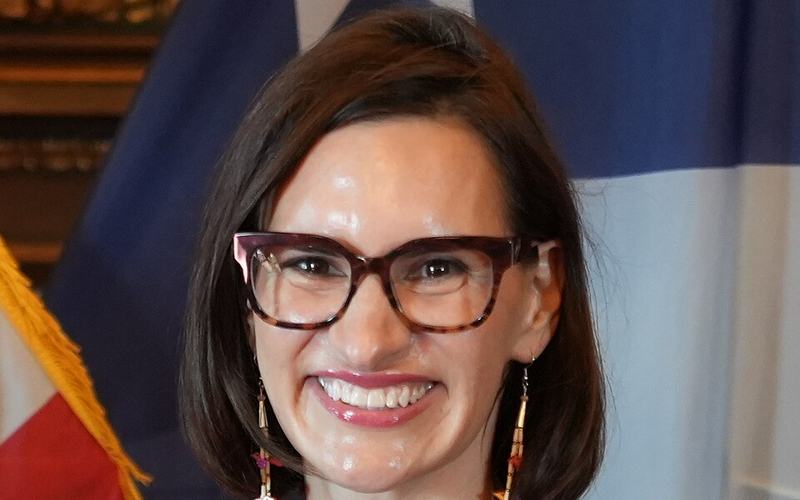
Minnesota Lt. Gov. Peggy Flanagan, the Democratic nominee for the U.S. Senate, has acknowledged that she never became a member of the Phi Beta Kappa academic honor society, despite telling state lawmakers in 2016 that she graduated as a member.
Flanagan’s campaign confirmed Tuesday that she had not joined the organization, eight days after The Wall Street Journal requested documentation supporting her claim. Campaign spokeswoman Alexandra Fetissoff said Flanagan had been nominated but could not afford the application fees.
“The lieutenant governor was nominated for Phi Beta Kappa, but like too many other students, she couldn't afford the application fees to become a part of the honor society,” Fetissoff said.
Flanagan made the disputed statement during a March 2016 legislative hearing while serving in the Minnesota House of Representatives. She was supporting legislation intended to increase teacher diversity in public schools and described how her college experience had changed her academic outlook.
“Everything changed, there was a switch, something clicked,” Flanagan said. “I graduated Phi Beta Kappa because I saw myself reflected in my teacher and I saw myself reflected in my curriculum.”
The Journal informed Flanagan’s campaign that Phi Beta Kappa’s national headquarters could release membership records with her permission. A University of Minnesota commencement program for her 2002 graduating class did not list her as an honors student, although the program highlighted graduates with grade-point averages of at least 3.5.
The university’s current GPA threshold for seniors considered for Phi Beta Kappa is 3.65. The society’s current lifetime membership fee at the university is $99, and some chapters waive fees or offer other accommodations for students facing financial hardship.
Questions have also emerged over Flanagan’s academic credentials. An official state biography said she earned bachelor’s degrees in American Indian studies and child psychology. Her commencement program listed child psychology as her major, while her campaign clarified that American Indian studies was a minor.
During the 2016 hearing, Flanagan discussed graduating from high school with a 1.75 GPA before finding greater academic engagement in college. She said teachers and coursework that reflected her background helped change her outlook, adding that she did not have a teacher she felt looked like her until her sophomore year at the University of Minnesota.
Flanagan has emphasized her Native American heritage throughout her political career. During her 2004 campaign for the Minneapolis School Board, she presented herself as a potential first Native American member.
The questions surrounding her academic record come as Flanagan campaigns against Republican Michele Tafoya, a former NFL sideline reporter, in a competitive Senate race. Recent polling cited by the Journal showed Flanagan leading by three to four percentage points.
The nonpartisan Cook Political Report shifted the race Tuesday to “lean Democrat,” one category short of a toss-up. The renewed scrutiny of Flanagan’s past testimony and official biography adds another issue for voters to consider as the Senate contest continues.

Comments
No comments yet. Be the first to share your thoughts.