
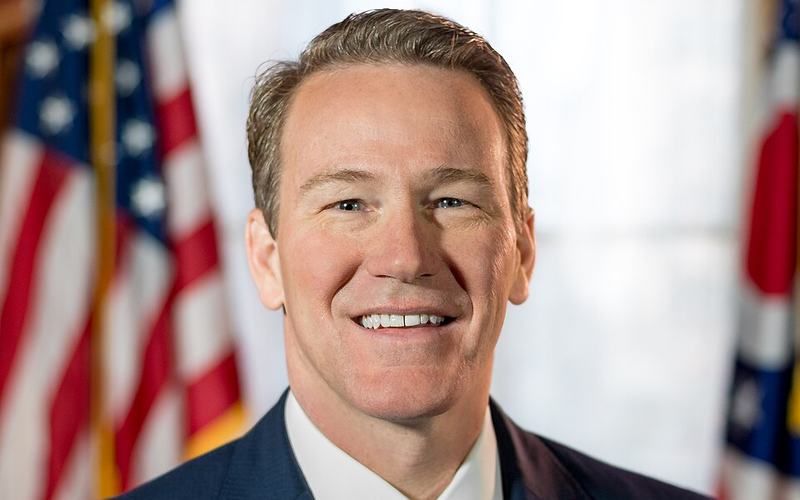
Sen. Jon Husted, R-Ohio, is turning to the growing debate over data centers and electricity costs as he seeks a late boost in his closely contested Senate race against former Democratic Sen. Sherrod Brown.
The Senate is expected to revisit Husted’s Ratepayer Protection Act this week after Democrats previously blocked an effort to pass it by unanimous consent. The legislation passed the House 417-3 and would require states to consider standards ensuring that large electricity users such as data centers cover the costs associated with additional generation and grid infrastructure.
Husted has argued that families and small businesses should not be forced to absorb the costs of infrastructure needed to support massive new data centers.
“I am responding to what the voters want,” Husted said, arguing that data centers should be held accountable for the costs associated with new electricity and infrastructure.
The issue has become increasingly significant as artificial intelligence has driven demand for large data centers capable of consuming enormous amounts of electricity. Concerns that the costs of expanding the electric grid could eventually be passed on to residential customers have made data centers a political issue in Ohio and other states.
For Husted, however, the issue comes with an additional complication. Before joining the Senate, he served for more than 20 years in Ohio state government and promoted data-center investments during his time as lieutenant governor. He also supported tax incentives used to attract the industry to the state.
That history has given Brown an opening to argue that Husted helped encourage the same data-center expansion he is now seeking to regulate. The issue has therefore become a point of contrast between the two candidates as voters consider the costs and benefits of the industry.
Husted acknowledged that his race against Brown has been difficult and said his campaign spent much of the summer being outspent. He said the spending gap had begun to narrow in recent weeks.
Recent polling shows a close contest, although Brown has led in each of the latest surveys. A Quantus Insights poll conducted Sept. 21-23 found Brown at 47.3% and Husted at 46.8% after undecided voters were included in the survey’s leaned results. A Trafalgar Group poll from Sept. 14-16 showed Brown leading 45% to 42%, while a Bowling Green State University/YouGov poll from Sept. 1-10 showed Brown ahead 48% to 45%.
The current RealClearPolling average has Brown at 48.2% and Husted at 44.2%, a four-point difference based on polls conducted through Sept. 23.
Husted’s legislation would not automatically require states to make data centers pay for every infrastructure upgrade. Instead, the bill requires state regulators to consider standards that would address the costs associated with connecting large electricity users to the grid.
The legislation has already become a partisan point of conflict in the Senate. Democrats previously blocked Husted’s attempt to pass the bill by unanimous consent, while Republicans argued that the move prevented Congress from addressing concerns over rising electricity costs. Democratic senators have argued that Husted’s proposal does not go far enough because it asks states to consider standards rather than directly requiring data centers to pay the full cost of the infrastructure they require.
Husted and his Republican allies are nevertheless pressing for another vote, allowing the senator to campaign on the issue heading into the final stretch of the election.
If the legislation advances, Husted can point to his effort to protect ratepayers from costs associated with the rapidly expanding data-center industry. If Democrats block it again, Republicans are positioned to make the vote part of their broader argument that Democrats are unwilling to support measures aimed at keeping electricity costs from being shifted onto consumers.
Sen. Bernie Moreno, R-Ohio, has backed Husted’s push and argued that lawmakers should be forced to take a recorded vote on the legislation.
The debate over Husted’s bill is therefore playing out on two fronts: whether Congress should require data centers to shoulder more of the costs associated with their enormous electricity demands, and how the issue could affect one of the most closely watched Senate contests of the 2026 election.

Comments
No comments yet. Be the first to share your thoughts.