
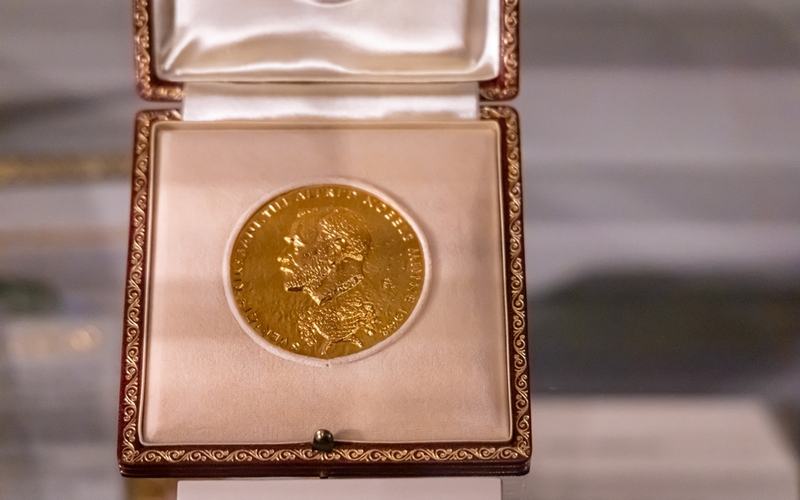
The Royal Swedish Academy of Sciences announced on Wednesday that Henri B. Kagan of France and Kenso Soai of Japan have won the 2026 Nobel Prize in Chemistry for their discoveries of non-linear effects and autocatalysis in asymmetric organic synthesis.
The award recognizes the pair's solution to a long-standing chemical puzzle involving chirality, or mirror-image molecules. Many molecules essential to life, such as amino acids, exist in two forms that are mirror images of each other, much like left and right hands. Living organisms typically use only one of these forms, known as homochirality, and the laureates' research demonstrated how chemical reactions can selectively produce one version over the other.
Kagan, 95, a professor emeritus at Université Paris-Sud in France, identified ways to manipulate reactions to produce a greater excess of one mirror image than previously thought possible. Soai, 76, a professor emeritus at Tokyo University of Science in Japan, developed experiments that achieved full asymmetry, creating chiral molecules from achiral starting materials for the first time in a laboratory setting.
Their findings have proven decisive for chemists designing reactions to manufacture pharmaceuticals, flavors, scents, and new materials. The ability to produce only the desired molecular form reduces side effects in drugs and improves precision in production.
Soai learned of the award while out grocery shopping and described it as one of the most exciting days of his life. The laureates will share the 12 million Swedish kronor prize. The chemistry award follows the medicine and physics prizes announced earlier this week.
The work builds on 19th-century observations by French chemist Louis Pasteur and addresses questions about the origins of life's molecular asymmetry. The official Nobel citation highlights the discoveries as a solution to a mystery over a century old.

Comments
No comments yet. Be the first to share your thoughts.