
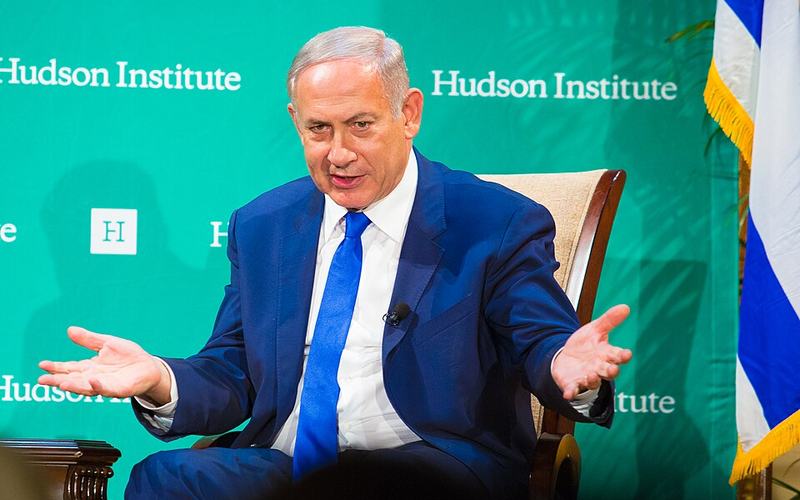
Israeli Prime Minister Benjamin Netanyahu offered Saturday to allow political rival Gadi Eisenkot to serve as prime minister first in a proposed national unity government, making a major concession as he attempts to prevent an opposition-backed coalition from removing him from power.
Netanyahu said he was willing to set aside his longstanding demand that Likud, Israel’s largest party, lead any unity government. Under the proposed arrangement, Eisenkot would initially serve as prime minister, while Netanyahu would become alternate prime minister and potentially take over later in the government’s term.
“My responsibility as a leader requires me to put everything aside, including the principle that the largest party should lead, and agree to Gadi Eisenkot serving first as prime minister, while I initially serve as alternate prime minister,” Netanyahu said in a statement.
Netanyahu argued that Israel’s security situation required political leaders to overcome their differences and establish a government capable of responding to threats facing the country.
The offer comes as Eisenkot, a former Israel Defense Forces chief of staff and chairman of the centrist Yashar party, races to assemble a governing coalition following Israel’s Oct. 27 election. The vote produced no clear majority for either Netanyahu’s bloc or Eisenkot’s opposition alliance in the 120-seat Knesset, which requires 61 members to support a government.
Netanyahu’s bloc won 53 seats, while Eisenkot’s bloc secured 48. Arab-led parties won the remaining 19 seats, leaving both political camps with difficult choices as they seek to form a government.
Israeli President Isaac Herzog tasked Eisenkot with forming the next government on Nov. 8, giving him 28 days to reach a coalition agreement, with the possibility of a two-week extension.
Netanyahu’s announcement followed growing pressure from Naftali Bennett, head of the B’Yachad party, who has advocated for a unity government involving Likud and Eisenkot’s coalition. According to reports, Bennett warned Netanyahu that he needed to offer Eisenkot the first turn as prime minister or risk losing B’Yachad’s support for the unity effort.
The proposal has not been universally welcomed within Eisenkot’s bloc. Yair Lapid, a leading figure in Bennett’s party and a former prime minister, rejected Netanyahu’s offer, describing it as a “transparent con” and arguing that Netanyahu has repeatedly deceived political partners and broken agreements.
Lapid said the proposal should be tested by first establishing a government led by Eisenkot without Likud, then negotiating whether Netanyahu’s party could join afterward.
Yair Golan, chairman of the Democrats party, also criticized Netanyahu’s move, saying the election results should be respected and that the opposition had a responsibility to form a new government.
Eisenkot’s coalition has already reached agreements with several potential partners, including the Democrats and Yisrael Beytenu. However, the bloc still needs additional support to reach a parliamentary majority, and negotiations with Likud have remained contentious.
Eisenkot has accused Netanyahu’s party of failing to negotiate seriously. He said the two sides had met only five times over two weeks and claimed Likud had refused to make meaningful commitments on major policy disputes.
Among the central disagreements are military conscription, the establishment of a state commission of inquiry into the failures surrounding the Oct. 7, 2023, Hamas terrorist attacks, and changes to Israel’s judicial system.
Eisenkot’s bloc campaigned on ending broad military-service exemptions for ultra-Orthodox men, a position that could complicate efforts to bring religious parties into a potential coalition. Netanyahu has indicated he is willing to work with his ultra-Orthodox partners toward a compromise on conscription and Torah study.
Netanyahu also warned Saturday that a government dependent on Arab-led parties could weaken Israel’s military position in Gaza, Lebanon and Syria and potentially lead to the establishment of a Palestinian state. He cited security concerns and the need to maintain Israel’s identity as the Jewish nation-state as reasons for forming a unity government.
The prime minister also criticized the defeat of legislation that would have barred the return of terrorists’ bodies to their families, presenting the issue as another example of the security challenges facing the country.
Netanyahu’s offer marks a significant shift in his negotiating position, but it does not guarantee that a unity government will be formed. Eisenkot has not immediately accepted the proposal, and disagreements within the opposition over whether to include Likud remain unresolved.
Eisenkot and Bennett are scheduled to meet Sunday to continue coalition discussions. Eisenkot’s deadline to form a government is approaching, leaving Israel’s political parties with limited time to reach an agreement or pursue alternative arrangements.
The negotiations could determine whether Netanyahu remains in power through a unity arrangement or whether Eisenkot succeeds in forming a government that ends the longtime prime minister’s tenure.

Comments
No comments yet. Be the first to share your thoughts.