
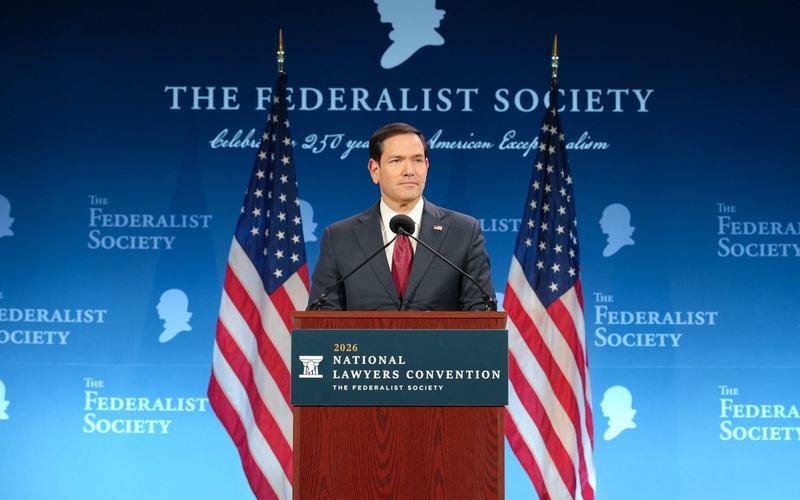
Secretary of State Marco Rubio has taken a substantial lead over Vice President JD Vance in an early look at the 2028 Republican presidential race, according to a November survey from Emerson College Polling. Rubio received considerably more support than Vance among Republican primary voters, reversing a trend from a year earlier when the vice president held a commanding advantage.
In an open-ended question asking Republican voters whom they would support without providing a list of candidates, Rubio received 36% support, compared with 20% for Vance. Florida Gov. Ron DeSantis, Rep. Thomas Massie, R-Ky., and Trump each received 7%. Trump is constitutionally prohibited from seeking another term.
Rubio's lead grew even larger when respondents were given a list of potential candidates. He received 44% support, nearly twice Vance's 24%. DeSantis followed with 9%, while Donald Trump Jr. received 6%.
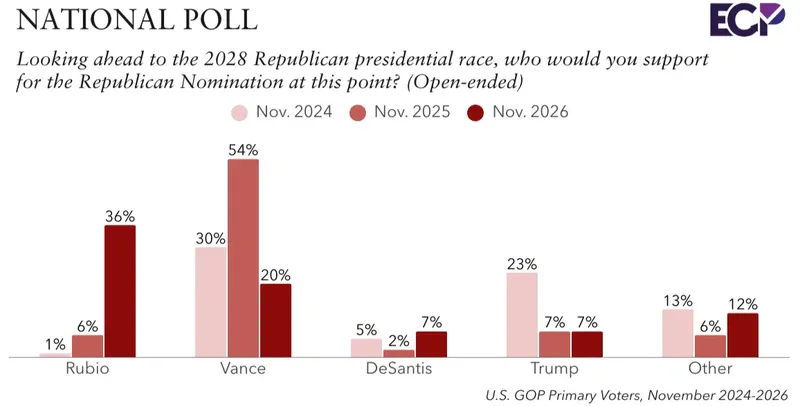
The results represent a major shift from November 2025. Rubio gained 30 percentage points in the open-ended question over that period, while Vance's support fell by 34 points, according to the poll.
Neither Rubio nor Vance has announced plans to run. Trump has suggested both men could eventually compete for the Republican nomination, while Vance recently told Fox News he expects to make a decision in 2027. He pointed to the significant fundraising and organizational demands involved in mounting a presidential campaign.
Rubio, meanwhile, has indicated he does not intend to seek the presidency. However, his growing support in the survey could increase speculation about whether he will reconsider as Republicans begin looking beyond Trump's presidency.
Democrats also have an unsettled field heading into 2028. Sen. Jon Ossoff, D-Ga., led the party's potential contenders with 17% support in the open-ended question. Rep. Alexandria Ocasio-Cortez, D-N.Y., received 12%, followed by California Gov. Gavin Newsom at 8%. Former Vice President Kamala Harris and former Transportation Secretary Pete Buttigieg each received 6%.
Ossoff recently won reelection but has said he is not interested in running for president.
The survey also measured public attitudes toward the two parties following Democrats' victories in the midterm elections. Trump's job approval stood at 37%, while 54% disapproved. The Republican Party received a 35% favorable rating and a 56% unfavorable rating. Democrats fared somewhat better, with 44% viewing the party favorably and 47% unfavorably.
Voters identified the cost of living as the leading priority for the next Congress, with 57% saying lawmakers should focus on the issue. Ending the war in Iran and banning congressional stock trading each received support from 49% of respondents as major priorities.
Emerson College Polling conducted the survey November 14-16 among 1,000 U.S. voters. The overall credibility interval was plus or minus three percentage points, with greater uncertainty for results involving smaller voter groups.

Comments
No comments yet. Be the first to share your thoughts.