
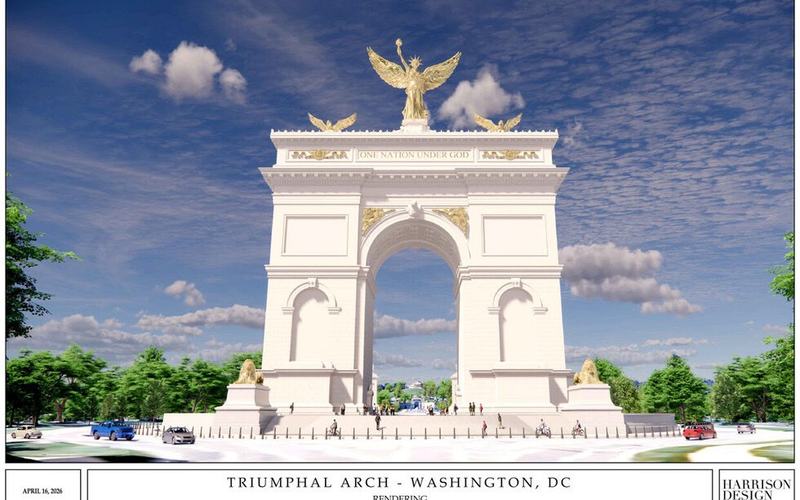
The Trump administration revealed detailed renderings on Friday for a proposed 250-foot triumphal arch in Washington, D.C., intended to commemorate America's 250th anniversary of independence.
The Interior Department, through architecture firm Harrison Design, filed a 12-page presentation with the Commission of Fine Arts for review next week. The structure, dubbed the Triumphal Arch or Independence Arch, would stand in Memorial Circle, a traffic roundabout at the end of the Arlington Memorial Bridge on Columbia Island, across the Potomac River from the Lincoln Memorial and near Arlington National Cemetery.
Renderings depict a white stone facade rising 166 feet, topped by a 25-foot pedestal, a 60-foot gilded winged Lady Liberty figure, and two 24-foot bald eagles, reaching a total height of 250 feet, one foot per year of U.S. independence. Four golden lions guard the corners, with golden inscriptions reading "ONE NATION UNDER GOD" on the front and "LIBERTY AND JUSTICE FOR ALL" on the rear. The central archway spans about 110 feet high, framing views toward the Lincoln Memorial. Internal staircases in the pedestals would access viewing platforms.
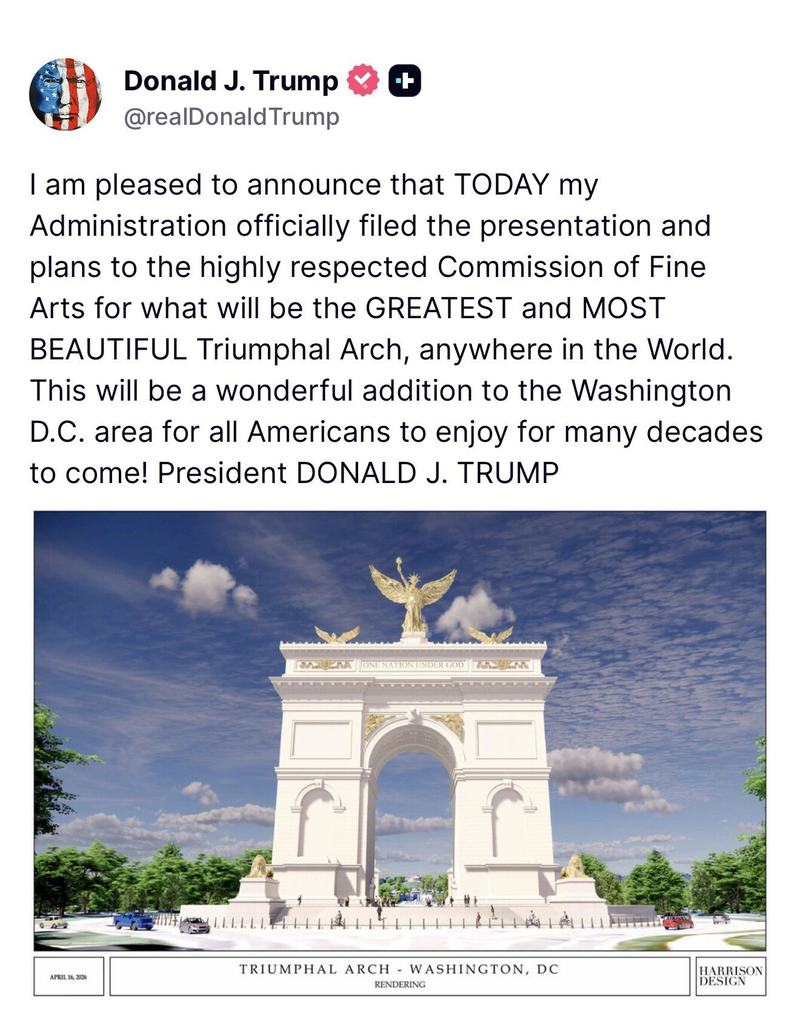
President Donald Trump announced the filing on Truth Social, calling it "the GREATEST and MOST BEAUTIFUL Triumphal Arch, anywhere in the World." A White House spokesman stated the arch would "enhance the visitor experience at Arlington National Cemetery for veterans, the families of the fallen, and all Americans alike, serving as a visual reminder of the noble sacrifices borne by so many American heroes."
The proposal, first floated by Trump in October 2025, draws inspiration from Paris' Arc de Triomphe but exceeds its 164-foot height. It dwarfs the 99-foot Lincoln Memorial across the river. Principal architect Nicolas Charbonneau of Harrison Design leads the effort, emphasizing classical design to beautify the capital.
The project ties to July 4, 2026, celebrations of the nation's semiquincentennial. Trump previously aimed to start construction by early 2026, though no groundbreaking date has been set. Funding details remain unclear, with earlier reports of private donations and recent mentions of $15 million from federal sources like the National Endowment for the Humanities.
The Commission of Fine Arts will review the plans amid ongoing debate.

Comments
No comments yet. Be the first to share your thoughts.