
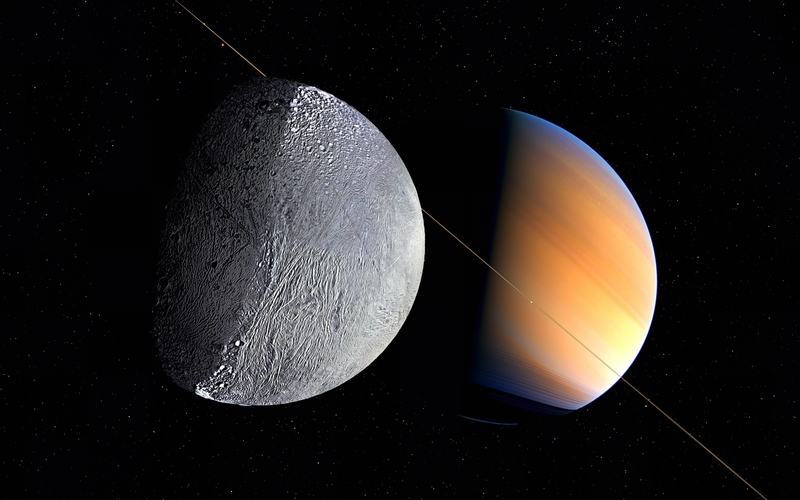
Enceladus, one of Saturn’s moons, may have the right conditions to support life beneath its frozen surface, according to recent research examining the moon’s internal heat and subsurface ocean.
Scientists have long considered Enceladus a promising target in the search for extraterrestrial life because it contains a global ocean of liquid water beneath its icy crust. NASA’s Cassini spacecraft also detected organic compounds, salts, and other chemical ingredients associated with habitability in material erupting from the moon’s interior.
A 2025 study using Cassini observations found evidence that heat is escaping from both of Enceladus’ poles. Researchers concluded that the moon’s total heat loss closely matches the amount of heat expected to be generated by tidal forces as Saturn’s gravity stretches and compresses Enceladus.
That balance could allow the subsurface ocean to remain liquid over geological timescales rather than eventually freezing. The researchers described a stable energy supply as an important prerequisite for an environment in which life could potentially develop.
More recent research has added to the picture. A study published in September found that certain Earth microorganisms were able to survive laboratory conditions designed to resemble Enceladus’ extreme subsurface environment. The researchers found that hydrogen-consuming, methane-producing microbes could adapt to the moon’s highly alkaline chemistry and limited carbon dioxide.
Scientists have also continued examining material ejected from Enceladus’ ocean through plumes at its south pole. Research published in October found that minerals formed from freezing ocean water can trap pockets of fluid, potentially preserving chemical information about the moon’s interior that could be examined by future missions.
The findings do not establish that Enceladus contains extraterrestrial life. Instead, they indicate that several fundamental requirements associated with habitability, including liquid water, an energy source, and the necessary chemical elements, may exist together beneath its ice.
That makes Enceladus one of the leading destinations in the search for life beyond Earth, with future missions potentially able to analyze material from its ocean without having to drill through the moon’s thick icy shell.

Comments
No comments yet. Be the first to share your thoughts.