
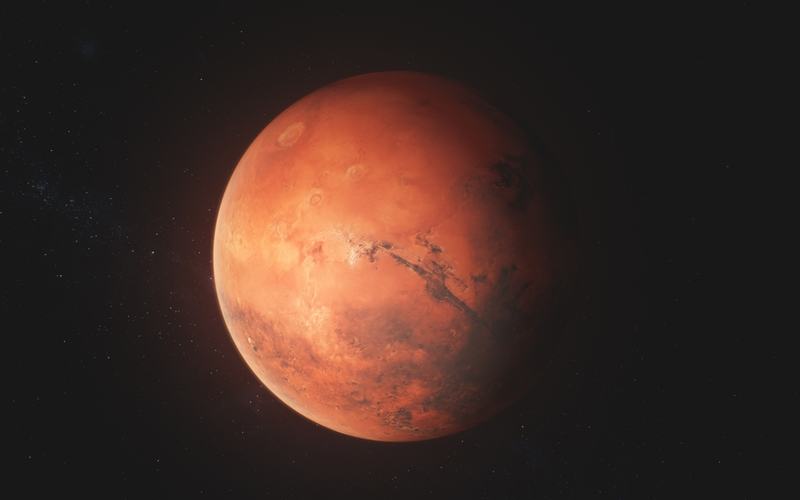
Scientists have discovered new evidence suggesting Mars may not be as geologically inactive as previously believed, with gases detected near volcanic fissures pointing to the possibility of magma and heat remaining beneath the planet’s surface.
An international research team identified unusual concentrations of hydrogen chloride gas in the Martian atmosphere above fractures on the slopes of Alba Mons, one of the planet’s largest volcanoes. The findings, published November 4 in the journal Science Advances, were based on observations from the European Space Agency’s ExoMars Trace Gas Orbiter.
Hydrogen chloride can be released by volcanic activity on Earth when magma rises toward the surface. Researchers believe the gas detected on Mars could be escaping from an underground magma chamber through cracks in the planet’s crust. Its appearance in the same location during early Martian summer, when the gas normally becomes scarce, has added to the evidence for a possible volcanic source.
The discovery suggests Mars may have retained enough internal heat to support volcanic activity until relatively recently, and potentially still does. However, scientists have not directly observed a new eruption or fresh lava flow, and the researchers acknowledge that other chemical processes could explain the gas.
The findings could also have implications for the search for life beyond Earth. If underground magma interacts with water beneath the Martian surface, it could create hydrothermal environments containing heat and chemical energy that might support microbial organisms. Such locations could also offer protection from the planet’s harsh surface conditions.
Researchers say the volcanic fissures around Alba Mons could therefore become important targets for future exploration. Although the discovery does not establish that life exists on Mars, it provides another reason to investigate whether conditions beneath the planet’s surface could support it.

Comments
No comments yet. Be the first to share your thoughts.