
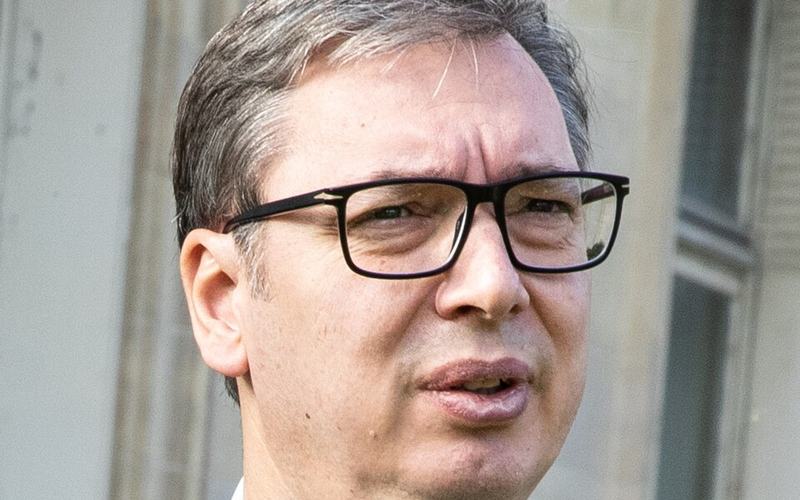
Serbia heads to the polls Sunday in a pivotal election that could return longtime political leader Aleksandar Vučić to the prime minister’s office, potentially reinforcing the country’s independent foreign policy and its growing relationship with the United States.
Vučić’s coalition holds a lead of more than seven percentage points, according to an Ipsos poll released this week. The result suggests public support may be shifting away from the protest movement that has challenged his government for nearly two years.
The election marks a significant change for Vučić, who resigned as president on Sept. 27, seven months before the end of his second term. Serbia’s Constitution bars him from serving another consecutive presidential term, prompting him to seek the premiership as the candidate of the Serbian Progressive Party.
The move could allow Vučić to remain at the center of Serbian politics while transferring executive authority from the presidency to the government.
The campaign follows a prolonged period of demonstrations and political tensions. Vučić has argued that foreign interests have supported efforts to destabilize Serbia’s elected government and economy, allegations that have become central to his broader defense of national sovereignty.
His warnings reflect concerns raised by some conservative movements elsewhere in Europe about foreign interference, political polarization and radical-left activism. Serbia’s protests have unfolded amid wider unrest and political disputes across the continent.
Serbia’s position on the international stage also gives the election significance beyond its population of approximately 7 million. The country remains outside both NATO and the European Union while pursuing an independent foreign policy and strengthening relations with the United States, Israel and the United Arab Emirates.
Serbia has emerged as a particularly Trump-friendly country in Europe. A 2024 Gallup survey found that 59% of Serbian respondents would have chosen Donald Trump over Kamala Harris in the U.S. presidential election, the highest level of support for Trump among European countries surveyed.
Trump recently praised relations between Washington and Belgrade when questioned by Newsmax Balkans outside the White House.
“We have very good relations with Serbia,” Trump said.
Serbian Foreign Minister Marko Đurić welcomed the remarks, describing them as an important confirmation of the relationship between the two countries. Washington and Belgrade have also launched a strategic dialogue involving Secretary of State Marco Rubio and Đurić, with discussions focused on economic cooperation, security and energy infrastructure.
For Vučić, stronger ties with the Trump administration reinforce his argument that Serbia can preserve its independence while developing productive partnerships with the United States and other American allies.
The economy is another major issue in the election. Serbia has maintained economic growth despite regional energy disruptions stemming from Russia’s war in Ukraine, although uncertainty over energy supplies, investment and economic weakness elsewhere in Europe remains a challenge.
Serbia’s dependence on imported oil and natural gas, particularly from Russia, has complicated efforts to diversify its energy sources. The government has emphasized infrastructure development, foreign investment and new energy partnerships as ways to sustain growth while retaining diplomatic flexibility.
Vučić has also cultivated ties with Israel and the United Arab Emirates. Serbia has expanded discussions with Israel on strategic and economic cooperation and remains one of the few European countries selling weapons to Israel. Relations with the UAE have grown through investment, trade and renewable-energy projects.
Vučić has maintained a close relationship with UAE President Sheikh Mohamed bin Zayed Al Nahyan. After the war began on Feb. 28, Vučić became the first European leader to travel to Abu Dhabi to demonstrate support for the Emirates as it faced Iranian attacks.
Sunday’s election will determine whether Vučić can secure another governing mandate after more than a decade of dominating Serbian politics. A victory could strengthen his position at home and reinforce Serbia’s ties with Washington, while a defeat could mark a major political turning point in the Balkans.
The outcome will also test whether Serbia’s approach of combining national sovereignty, economic pragmatism, and partnerships with multiple international powers can retain public support amid sustained political opposition.

Comments
No comments yet. Be the first to share your thoughts.