
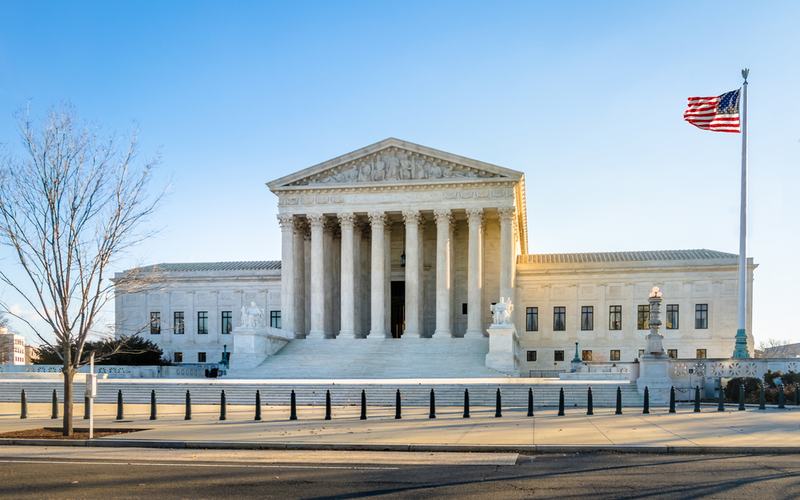
The Supreme Court declined Monday to hear a First Amendment challenge from two Michigan middle school students who were ordered to remove “Let’s Go Brandon” sweatshirts, leaving a lower court ruling allowing the school’s ban in place.
The justices did not explain why they declined the case, which involved two brothers at Tri County Middle School in Howard City, Michigan. A teacher and assistant principal ordered the students to remove the sweatshirts, saying the slogan was equivalent to profanity.
The students’ mother sued the school district in 2023, arguing that the ban violated her sons’ First and Fourteenth Amendment rights. The Foundation for Individual Rights and Expression represented the students in the case.
The Cincinnati-based Sixth Circuit Court of Appeals ruled 2-1 in October 2025 that the school could prohibit the phrase as vulgar speech even though it conveyed a political message.
Judge John Nalbandian, a Trump appointee, wrote that “in the schoolhouse, vulgarity trumps politics.” Judge Karen Nelson Moore, a Clinton appointee, joined the majority.
Judge John Bush, another Trump appointee, dissented, warning that allowing schools to classify political speech as vulgarity could give them a broad tool for censorship.
“If we allow schools the power to censor political speech by recharacterizing it as vulgarity, we risk turning disagreement with political speech into justification for its censorship,” Bush wrote.
The phrase “Let’s Go Brandon” became a political slogan in 2021 after NBC reporter Kelli Stavast interpreted a crowd chanting an obscenity directed at then-President Joe Biden as a chant supporting NASCAR driver Brandon Brown.
FIRE attorney Conor Fitzpatrick argued that the slogan remains protected political expression.
“Criticism of the president is core political speech protected by the First Amendment,” Fitzpatrick said. “Whether it’s a Biden sticker, ‘Let’s Go Brandon’ sweatshirt, or gay pride T-shirt, schools can’t pick and choose which political beliefs students can express.”
The school district has maintained that the shirts were prohibited under its dress code because of their vulgar meaning, rather than because of their political viewpoint. The district argued that lewd messages can be restricted in schools even when they carry a political message.
The Supreme Court’s decision leaves the Sixth Circuit ruling intact and does not establish a nationwide rule governing similar political slogans in schools.
The justices previously declined in May 2025 to hear another student free-speech case involving a Massachusetts middle schooler whose school barred a shirt reading “There are only two genders.” Justices Samuel Alito and Clarence Thomas publicly dissented from that decision.

Comments
No comments yet. Be the first to share your thoughts.