
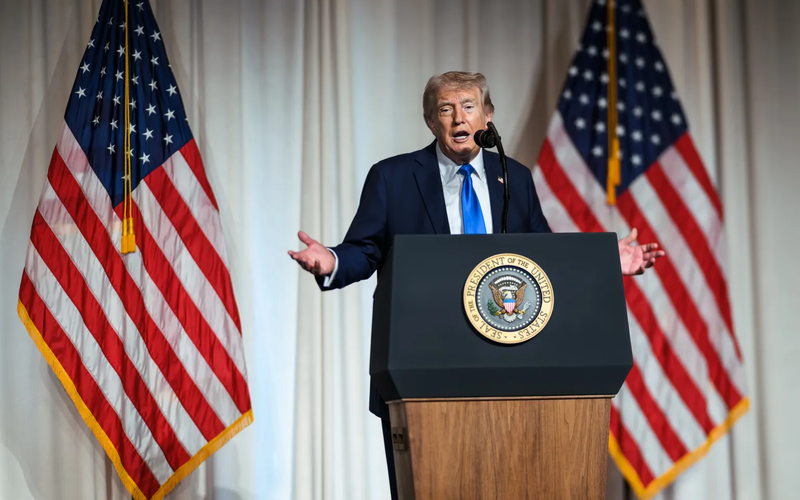
President Donald Trump announced Friday that the United States will raise tariffs on cars and trucks imported from the European Union to 25 percent starting next week.
In a post on Truth Social, Trump wrote: "I am pleased to announce that, based on the fact that the European Union is not complying with our fully agreed to Trade Deal, next week I will be increasing Tariffs charged to the European Union for Cars and Trucks coming into the United States. The Tariff will be increased to 25%." He added that companies producing vehicles in U.S. plants would face no tariffs and highlighted over $100 billion in investments for new American auto factories.
Trump reiterated the message to reporters as he departed the White House for Florida, stating the move would force European manufacturers to accelerate production in the United States. The announcement escalates tensions over the Turnberry Agreement, a trade framework Trump and European Commission President Ursula von der Leyen struck last July at Trump's golf course in Scotland. That deal capped U.S. tariffs on most EU goods, including autos, at 15 percent.
The EU expected the agreement to save its automakers 500 million to 600 million euros monthly. EU-U.S. trade in goods and services reached 1.7 trillion euros in 2024. However, a Supreme Court ruling questioned Trump's authority to impose the tariffs via economic emergency declarations, leading to a temporary 10 percent rate while the administration probes trade imbalances and national security concerns.
Trump has accused the EU of routinely failing to honor deals, though he provided no specific violations in Friday's statement. The European Commission affirmed its commitment to the Turnberry Agreement in February, insisting "a deal is a deal" and expecting no tariffs beyond the 15 percent ceiling.
The tariff hike arrives amid global economic fragility, exacerbated by the ongoing war in Iran, which has driven up oil and natural gas prices, slowed growth, and fueled inflation after the Strait of Hormuz closure. European automakers, major U.S. exporters like Volkswagen and BMW, could face higher costs passed to consumers or shifts in supply chains.
U.S. manufacturers stand to benefit as the policy incentivizes domestic production. Trump touted record investments in American plants employing U.S. workers. Earlier broad auto tariffs announced in March 2025 had prompted similar shifts, though negotiations led to the EU cap.
European officials have not yet responded to Friday's announcement, given its recency. Past tariff moves drew vows of retaliation from Germany and others, but recent U.S.-EU dialogues had improved ties. Markets showed no major immediate swings by mid-afternoon, though European auto shares have dipped on prior threats.
The White House has not released further details on implementation or exemptions. Commerce Secretary investigations continue into whether EU practices threaten U.S. security.

Comments
No comments yet. Be the first to share your thoughts.