
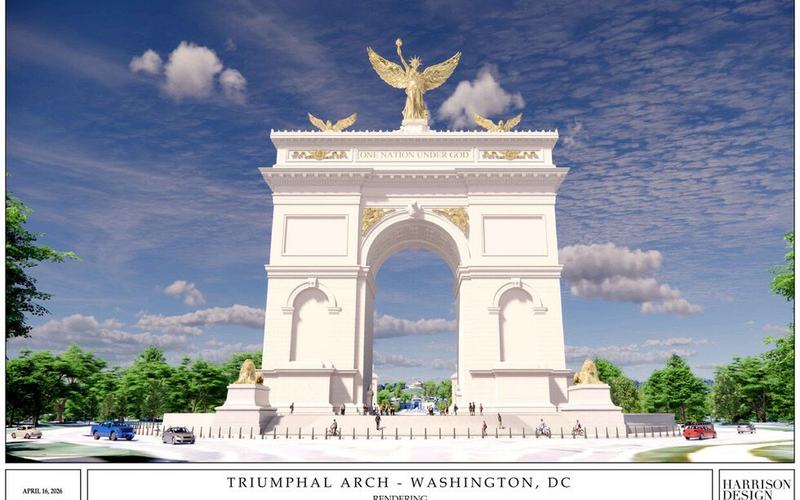
Construction of President Donald Trump’s proposed 250-foot-tall arch near Arlington National Cemetery could begin as early as Nov. 5, the same day a federal planning commission is scheduled to vote on the project, according to a notice the Justice Department filed with a federal judge Wednesday.
The notice outlines the steps required before work can begin. The National Capital Planning Commission must approve the final site and building plans, followed by approval from the Interior Department. The National Park Service must then publish notice of the authorization before construction or demolition to prepare the site can begin.
Government lawyers filed the notice under an April consent order requiring the administration to provide advance notice before work starts. The Nov. 5 date therefore marks a potential start, not a confirmed construction date, because the project still depends on the required approvals.
The proposed arch would stand in Memorial Circle, federal parkland beside Arlington Memorial Bridge, which connects Washington, D.C., with Northern Virginia. The reinforced-concrete structure would be clad in stone, measure 166 feet wide and rise near one of the nation's most prominent military memorial landscapes.
The project has drawn criticism from opponents who argue that the structure would alter historic views, including the sightline between the Lincoln Memorial and Arlington National Cemetery. Supporters of the project have described the arch as a commemorative landmark, while critics question whether it can legally be built without congressional authorization.
The dispute is already being fought in federal court. A lawsuit filed in February by Vietnam War veterans Michael Lemmon, Shaun Byrnes and Jon Gundersen, along with retired architectural historian Calder Loth, argues that the Commemorative Works Act of 1986 bars the project without congressional approval. The law governs commemorative works on certain federal lands in Washington and the surrounding area.
U.S. District Judge Tanya Chutkan, an appointee of former President Barack Obama, is overseeing that case. The plaintiffs are challenging the administration’s authority to proceed with the project under the law.
The planning process has also drawn attention because the administration has reshaped the federal commission responsible for reviewing the arch. Political appointees, including two senior aides to Secretary of War Pete Hegseth and two Interior Department officials, have replaced career officials serving as alternate commissioners on the National Capital Planning Commission, according to The Washington Post.
Commission Chairman Mark Paoletta, a White House official, has indicated that he intends to approve the project. In a social media post cited by the newspaper, Paoletta called the empty circle where the arch is proposed to stand “a disgrace to our nation and her noble veterans.”
A separate legal challenge has been filed by Arlington County, Virginia. The county’s governing board sued the National Park Service in federal court in Alexandria on Oct. 8, arguing that the agency improperly failed to prepare an environmental impact statement under the National Environmental Policy Act.
County Board Chair Matt de Ferranti said Arlington has “the most to lose from this egregious and unlawful proposed project,” according to The Associated Press. A White House spokesman told the AP that the administration is complying with legal requirements and expects the county’s lawsuit to be dismissed.
U.S. District Judge Leonie Brinkema, an appointee of former President Bill Clinton, is overseeing the county’s case. Both lawsuits remained pending as of Thursday, leaving the arch’s legal future unresolved even as the federal review moves toward its scheduled vote.
The Nov. 5 timeline places the project at a significant juncture. If federal officials approve the required plans and complete the remaining authorization steps, work could begin while legal challenges remain active. The lawsuits, however, raise questions about whether the project has the necessary legal authority and environmental review to proceed.
For now, the administration’s notice establishes a possible timetable rather than a guarantee that construction will begin on Nov. 5. The planning commission’s decision, Interior Department approval, and the outcome of the pending litigation could all affect the project’s path forward.

Comments
No comments yet. Be the first to share your thoughts.