
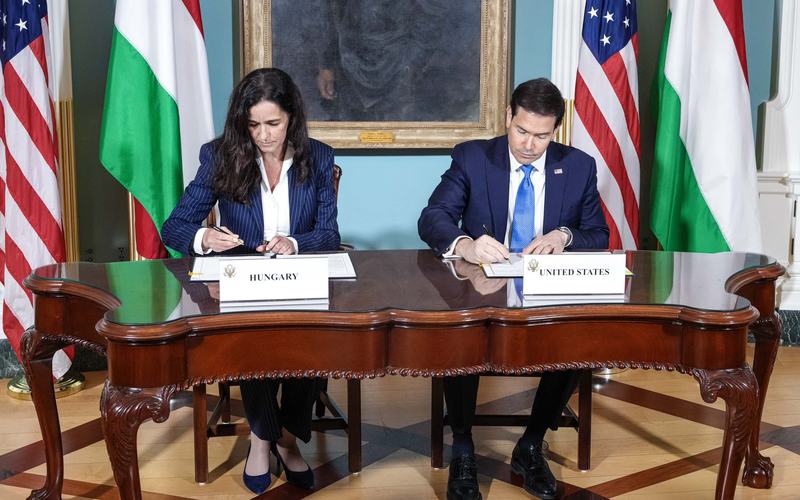
The United States and Hungary signed two memorandums of understanding Thursday at the State Department in Washington, establishing plans to strengthen regional energy infrastructure and expand law enforcement cooperation, including information sharing to combat violent left-wing organizations.
Secretary of State Marco Rubio and Hungarian Foreign Minister Anita Orban signed the agreements as the Trump administration pursues its Trump Peace Pipelines framework, a U.S.-led initiative intended to improve energy infrastructure and expand Central and Eastern Europe's access to American supplies.
The energy memorandum builds on an initiative announced by Energy Secretary Chris Wright at the Three Seas Initiative summit in Dubrovnik, Croatia, on April 28. The Energy Department described the framework as an effort to improve regional infrastructure and increase the capacity to import American liquefied natural gas.
Rubio said the initiative would help Central European countries meet their energy needs with U.S. supplies while giving them more options for sourcing energy.
The agreement is intended to support oil and natural gas infrastructure across Central and Southeastern Europe, potentially helping countries diversify supplies and reduce reliance on limited sources. However, officials did not announce specific pipeline routes, investment amounts, construction schedules, or new energy purchase commitments during Thursday's ceremony.
Orban said Hungary views the agreement as an important step toward becoming a larger participant in regional energy supply. She said the goal is to secure predictable, stable and affordable energy for Hungarian households, industry and the broader economy.
Both officials emphasized that the memorandum establishes a framework for further work rather than finalizing specific infrastructure projects. Orban said the next steps would involve developing action plans and reaching additional agreements.
Rubio described the memorandum as evidence of expanding economic cooperation between Washington and Budapest, saying the two countries could work together to produce practical benefits for their citizens.
The second memorandum focuses on law enforcement cooperation and information sharing to identify and prosecute cross-border networks accused of carrying out politically motivated violence and property destruction.
Rubio said the networks target police, critical infrastructure, and historical landmarks, describing them as an international threat to Western societies. He said the United States and Hungary would work together to track their activities and hold those responsible accountable.
Orban specifically identified Antifa Ost, a German-based far-left militant group, as one of the organizations addressed by the agreement. She said enhanced information sharing would help authorities prevent, detect, and prosecute violence associated with left-wing groups in both countries.
The agreements add energy security and law enforcement to the areas of cooperation between the United States and Hungary. Their practical effects will depend on the specific projects, action plans, and enforcement arrangements developed after the memorandums were signed.

Comments
No comments yet. Be the first to share your thoughts.