
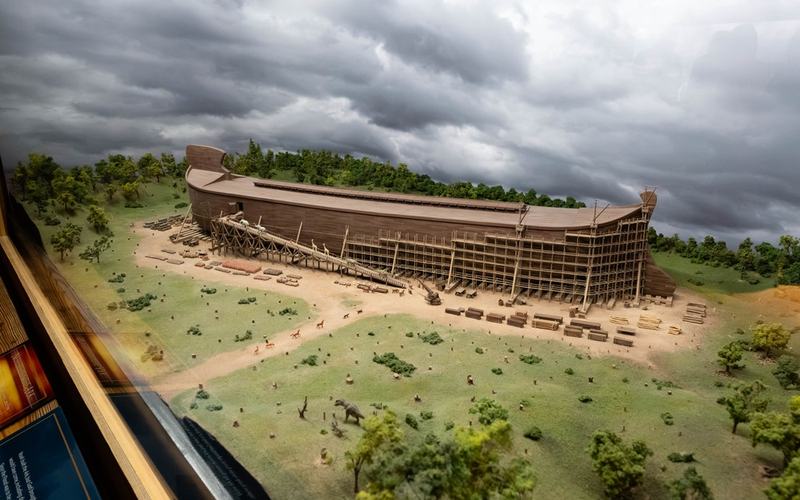
Researchers investigating a large, boat-shaped geological formation in eastern Turkey say they have potentially discovered charred and uncharred wood nearly 30 feet underground, raising new questions about whether the site could be connected to the biblical account of Noah’s Ark.
Andrew Jones, founder and project leader of Noah’s Ark Scans, told the Daily Mail that the team uncovered what could be remnants of the legendary vessel at the Durupınar Formation, a geological structure approximately 538 feet long and located about 18 miles south of Mount Ararat.
The formation was identified in 1959 and has attracted the attention of Ark researchers for decades because of its distinctive shape and proximity to the mountain traditionally associated with the biblical account.
According to the Book of Genesis, Noah built an enormous vessel to protect his family and representatives of the animal kingdom from a catastrophic flood. The biblical narrative describes the Ark coming to rest in the mountains of Ararat, although the exact location and historical interpretation of the account remain subjects of debate.
Jones and his team believe their findings could strengthen the argument that the Durupınar Formation is not simply a natural geological feature. However, the discovery of wood fragments alone does not establish that the material came from the biblical vessel.
Jones acknowledged that the charred material could have another explanation. He suggested it might have originated from a campfire lit by a shepherd who sought shelter at the site centuries ago. Researchers have not determined whether the wood was deliberately burned or exposed to a natural event such as a lightning strike or volcanic activity.
The possibility of burning has also prompted speculation about preservation. Jones suggested that charring could have slowed the decomposition of some wood under certain conditions, potentially allowing remnants to survive underground. The researchers have not established that this process occurred at the site.
The biblical account describes Noah coating the Ark with pitch to waterproof it, a substance that is also flammable. Researchers have pointed to that detail as a possible connection, although it does not independently verify the formation’s identity.
Noah’s Ark Scans has previously used ground-penetrating radar to investigate what the team describes as underground chambers and corridors within the formation. Jones has argued that the structures appear consistent with spaces that might have been used to house Noah’s family and the animals described in Genesis.
One central cavity identified in the team’s interpretation has been dubbed the “Atrium.” Jones has suggested that the alleged chambers could correspond to areas where animals and people were housed during the flood.
The team has also cited differences in soil composition as evidence warranting further investigation. According to its analysis, soil collected from inside the formation contained approximately three times as much organic matter and 38 percent more potassium than samples collected outside it.
Jones has argued that the elevated organic content could be consistent with decomposed wood, but soil differences can have multiple explanations. Additional testing would be needed to determine the source of the material and whether it has any connection to a wooden structure.
The researchers also reported that a drilling and scanning expedition last fall found no natural bedrock directly beneath the formation, contrary to one explanation offered by critics. Instead, the team encountered rich, dark soil that it plans to examine for evidence of decayed wood and other organic material.
“Noah’s Ark was a giant wooden boat, according to the Bible,” Jones said. “As wood decays, you’re gonna find elevated organic matter.”
The team plans to continue analyzing samples in an effort to determine what lies beneath the formation. For now, the claims remain unconfirmed, and the available findings have not established that the Durupınar Formation is Noah’s Ark.
The investigation nevertheless continues to draw attention to a site that has long fascinated biblical archaeology enthusiasts. Whether future testing can identify the origin and age of the buried material remains an open question.

Comments
No comments yet. Be the first to share your thoughts.