
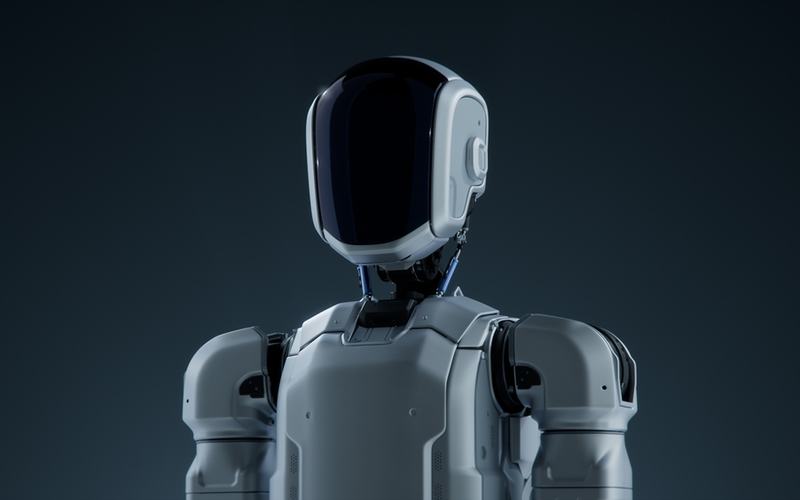
U.S. production of humanoid robots could reach 300,000 to 400,000 units annually by 2030 and approximately 1.5 million units by 2035, according to a Thursday forecast from J.P. Morgan. The projection reflects an industry moving beyond demonstrations and early testing toward broader commercial deployment.
Businesses in manufacturing, logistics and warehousing are increasingly exploring humanoid robots to automate repetitive tasks. J.P. Morgan identified labor shortages, improving cost economics and expanding production capacity as major factors driving adoption.
The Trump administration's determination that imported robotics and industrial machinery pose national security risks could also help accelerate domestic manufacturing. J.P. Morgan said the finding could lead to tariffs or other measures designed to strengthen U.S. production.
However, the industry faces several obstacles to scaling up. Hardware limitations, the availability of training data and computing power for robot intelligence, and manufacturing capacity remain significant constraints. Most U.S. manufacturers outside Tesla are targeting annual production of roughly 10,000 to 30,000 units, well below the levels projected for the broader industry later in the decade.
J.P. Morgan estimates that humanoid robot costs are approaching parity with human labor costs. Deploying robots across multiple shifts could generate approximately $100,000 in annual savings per customer, potentially making the technology more attractive to businesses seeking to reduce operating expenses.
The brokerage identified hands, actuators, robot intelligence systems and production capacity as the industry's most immediate bottlenecks. It expects suppliers of key components, including actuators, motors and vision systems, to benefit as manufacturers increase output. The market for those components could approach $30 billion by 2035.
Among U.S. companies developing humanoid robots, J.P. Morgan highlighted Tesla's Optimus, Agility Robotics' Digit, Boston Dynamics' Atlas, Figure AI's robots and Apptronik's Apollo. The brokerage also identified component suppliers Timken, Robotis, Leader Drive, Orbbec and Cognex as companies it favors.
J.P. Morgan expects the distribution of industry profits to evolve as the market matures, with component suppliers positioned to benefit in the near term before more value shifts toward robot manufacturers and companies integrating the technology into commercial platforms.

Comments
No comments yet. Be the first to share your thoughts.