
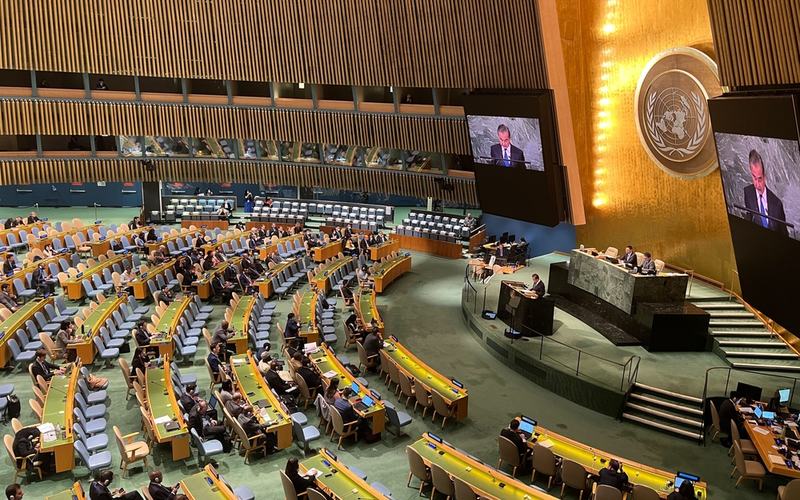
The United States rejected a draft United Nations political declaration on pandemic prevention, preparedness and response at a high-level meeting in New York on Friday.
U.S. representative Erika Schwartz, director of the Centers for Disease Control and Prevention, stated that the United States is not in a position to support the text in full. She cited the inclusion of divisive ideologies that lack definitional consensus and references to an unfinished negotiation on pathogen access and benefit sharing.
The nonbinding declaration was intended to build political momentum for international cooperation on future pandemics following the COVID-19 outbreak. It called for scaling up preparedness, improving coordination, enhancing financing, boosting laboratory capacity and promoting access to medications and vaccines.
The United States has withdrawn from the World Health Organization and did not participate in finalizing the related pandemic agreement approved by WHO member countries last year. The document under discussion at the United Nations General Assembly session was a follow-on political statement rather than a treaty.
The European Union also raised objections, primarily over provisions involving intellectual property and technology transfers, arguing that such sharing should remain voluntary and on mutually agreed terms. Other nations including Italy declined to endorse the text, while some countries expressed concerns without outright rejection.
General Assembly members will consider the document in future sessions. Proponents had hoped for consensus to signal strong international commitment, but the lack of agreement highlights ongoing divisions over financing accountability, prevention priorities and ideological content.
The meeting occurred amid an ongoing Ebola outbreak in the Democratic Republic of the Congo, with officials noting the need for better global coordination on health emergencies.

Comments
No comments yet. Be the first to share your thoughts.