
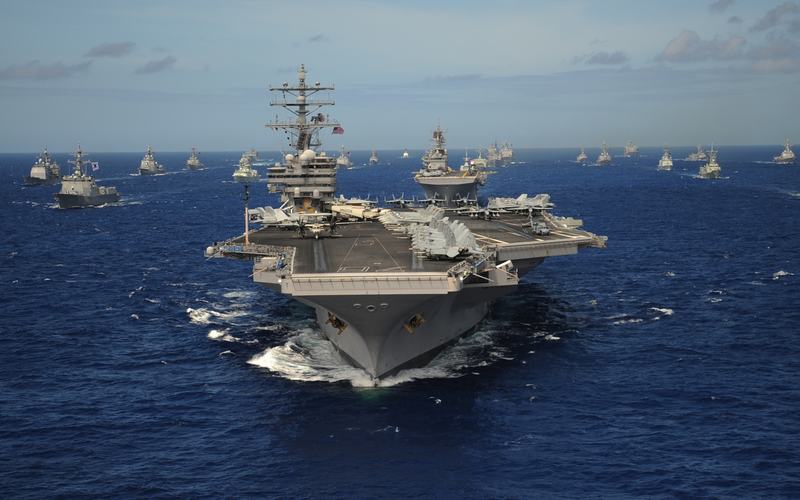
The USS Theodore Roosevelt departed San Diego Sunday for an expected Middle East deployment as the Iran war enters its eighth month and the Navy works to rotate forces that have operated for extended periods in the region.
The Nimitz-class aircraft carrier left as the flagship of Carrier Strike Group 9 and is expected to embark Carrier Air Wing 11. A War Department official confirmed the carrier had begun its planned deployment. The Roosevelt is expected to relieve the Japan-based USS George Washington, which entered the U.S. 5th Fleet area in mid-August. The USS George H.W. Bush is also operating in the Middle East, leaving two carrier strike groups in the region while the Roosevelt transits.
The deployment occurs as U.S. military operations against Iran continue following President Donald Trump’s order to begin the campaign on Feb. 28. American naval forces have played a central role. U.S. Central Command said Friday that U.S. forces had redirected 122 commercial vessels since resuming a naval blockade against Iran in July. The restrictions apply to vessels entering or leaving Iranian ports; ships transiting the Strait of Hormuz to non-Iranian ports have been allowed to proceed. An earlier phase of the blockade, from April 13 to June 18, redirected more than 140 vessels.
The Strait of Hormuz remains critical to global energy flows. The U.S. Energy Information Administration estimated that 21.6 million barrels of oil per day passed through the waterway in the fourth quarter of 2025, falling to an estimated 4.9 million barrels per day in the second quarter of 2026 as the conflict disrupted regional energy traffic. The EIA has noted that ship-tracking data have become less reliable since the war began.
The Roosevelt’s arrival will also help relieve the USS Abraham Lincoln, which has operated in the Middle East for more than eight months and was near Hawaii on Sunday while returning to California after an extended deployment without a port call. As of Monday, the Lincoln had been deployed for 311 days.
Those lengthy deployments have raised concerns about effects on sailors and families. Chief of Naval Operations Adm. Daryl Caudle said in August that repeated extensions make it difficult for families to plan because they often see no clear endpoint. Master Chief Petty Officer of the Navy John Perryman said Roosevelt families were preparing for a deployment lasting more than seven months, with the carrier’s commanding officer providing an eight-month planning estimate.
The Roosevelt’s deployment reflects the Navy’s effort to maintain carrier presence in the Middle East while rotating crews that have spent months operating in a wartime environment. The carrier is expected to take over for the George Washington as U.S. naval operations continue.

Comments
No comments yet. Be the first to share your thoughts.