
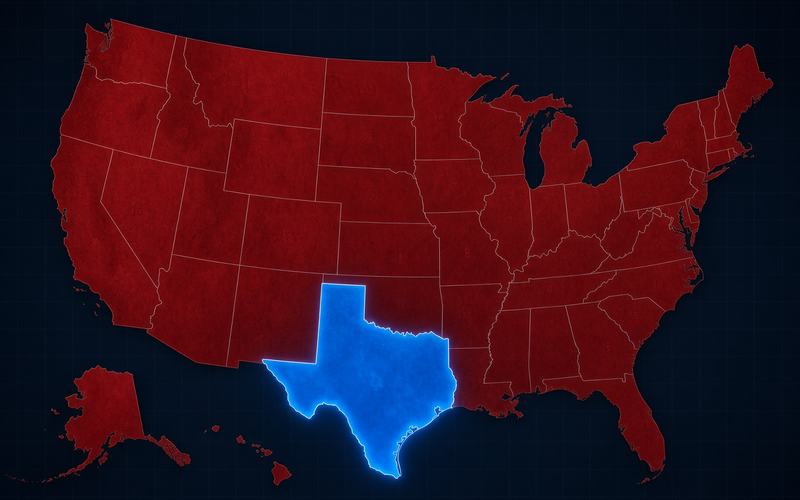
Texas’s 40 electoral votes have long been the unmovable foundation of Republicans' path to the White House. Lose them, and the entire map collapses. The just-concluded 2026 midterms, in which Democrats swept Texas statewide offices including the governorship and a U.S. Senate seat for the first time in decades, make that once-remote scenario feel uncomfortably plausible heading into 2028.
In 2024, Donald Trump carried Texas by nearly 14 points (56.1% to 42.5%), securing all 40 electors and finishing with 312 electoral votes to Kamala Harris’s 226. That margin was the largest for a Republican in the state in years and reflected gains among Hispanic voters in South Texas alongside strong rural and suburban support. Yet midterm turnout and candidate quality differ from presidential races. A Democratic presidential nominee in 2028 who simply matches or modestly underperforms the 2026 statewide performance could put Texas in play or even flip it.
The arithmetic is brutal. Texas’s 40 votes represent the second-largest prize after California’s 54. Moving them from the Republican column to the Democratic one is an 80-vote swing. Adding Texas’s 40 to the roughly 226 electoral votes Democrats already hold in their coastal, urban, and upper-Midwest strongholds (California, New York, Illinois, and the rest of the solid blue base) gets them to approximately 266—within striking distance of the 270 needed to win. From there, they would need only a handful of additional electors from places like Minnesota, New Mexico, or Maine.
Republicans, by contrast, would start deep in a hole. Their traditional safe states—Florida (30), Ohio (17), the Deep South, the Great Plains, and the Mountain West—would still deliver a solid but insufficient base once Texas is removed. To reach 270 without Texas, the GOP nominee would have to sweep virtually every remaining battleground: Georgia, North Carolina, Arizona, Nevada, Pennsylvania, Michigan, and Wisconsin, plus hold or reclaim any lean-Republican states that drift. That is a near-perfect map with almost no margin for error. Historical precedent shows how difficult such clean sweeps are when national conditions are even slightly adverse.
Democrats understand the stakes. Texas combines rapid population growth (driven by domestic migration from high-tax blue states), expanding urban metros in Houston, Dallas, Austin, and San Antonio, and a large Hispanic population. If Democratic policies on energy, taxes, education, and the border prove more popular than expected, or if Republican turnout softens, the state’s long Republican streak—unbroken since 1976—could end. After the 2030 census, Texas is projected to gain still more House seats and thus electoral votes, amplifying any shift.
Conservatives should not treat the 2026 results as destiny. Midterms often punish the party in power and feature lower turnout among presidential-year voters. Texas under Republican governance has delivered no state income tax, robust energy production, and relative economic strength compared with high-cost blue states. The state’s voters have repeatedly rejected the higher taxes, regulatory burdens, and cultural priorities that define Democratic governance elsewhere. Those advantages remain real.
Still, the warning is clear. A blue Texas would not merely cost Republicans one large state. It would reconfigure the Electoral College for a generation, turning what has been a competitive map into one in which Democrats begin nearly at the finish line and Republicans must run a flawless gauntlet of swing states. Preventing that outcome requires focusing relentlessly on the issues that have kept Texas red: energy independence, border security, and economic freedom. The alternative is a map in which the path to 270 for a Republican nominee becomes vanishingly narrow.

Comments
No comments yet. Be the first to share your thoughts.