

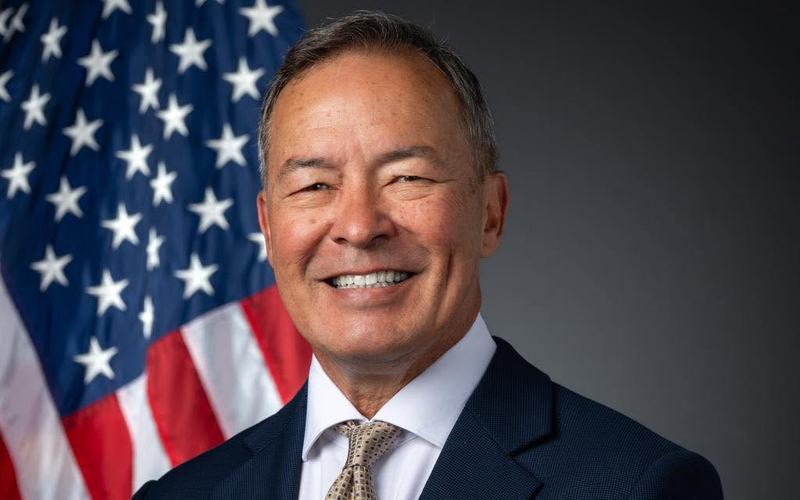
Incumbent Republican James Moylan entered the 2026 race for Guam’s non-voting At-Large House delegate with two advantages: incumbency and a respectable financial war chest. Unofficial results from the Guam Election Commission prove that neither was enough to prevent his defeat at the hand of Democratic challenger and former Guam Attorney General Alicia Limtiaco.
Unofficial final results from the Guam Election Commission showed that Limtiaco received 15,645 votes, or about 51 percent, while Moylan tallied 14,983 votes, or about 49 percent, out of more than 30,600 ballots cast in the race. Voter turnout reached 53.11 percent of registered voters.
The outcome flipped the seat, marking a reversal from Moylan's own underdog win when he flipped the seat for the GOP in 2022 with 52.12 percent of the vote to become the first Republican elected to the seat since 1993. Moylan won reelection in 2024 with a similarly 52.69 percent performance that polls had not counted on. Limtiaco’s win ends the Republican's hold on a position Democrats had controlled for decades before him.
Campaign finance reports prior to the general election show that Moylan outraised and outspent Limtiaco massively in the race. According to Federal Election Commission filings, he had raised roughly $249,000 in the race and spent about $192,000 by mid-October. Limtiaco, on the other hand, report raising just under $50,000 and having spent about $27,000.
That equates to an approximately 7-to-1 gap on spending.
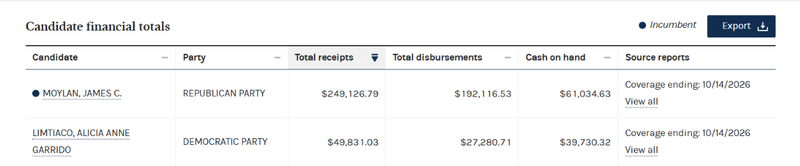
Moylan’s war chest came mostly from local individual donors from Guam addresses. However, he also saw substantial mainland Republican support. Of his roughly $249,000 in receipts through mid-October, about $170,000 came from individuals. Business owners, executives, realtors, his own family members, and other Guam residents provided the bulk of that money. He also reported a modest $1,000 candidate contribution.
The remaining roughly $78,000 arrived from other political committees and PACs. Among these, support from House Majority Whip Tom Emmer of Minnesota stood out as the clearest engagement from senior GOP leadership. Emmer’s leadership PAC, Electing Majority Making Effective Republicans, contributed $15,000, and Emmer for Congress contributed an additional $4,000 in early October. Other leadership and conservative PACs based in Virginia, Maryland, and elsewhere added further sums, but the filings do not show comparable late-cycle contributions from other top House Republican leaders such as Speaker Mike Johnson or Majority Leader Steve Scalise.

Rep. Emmer was the most prominent, and perhaps the only, senior leadership actively supporting Moylan’s reelection effort.
Limtiaco’s funding looked entirely different. Every dollar of her roughly $49,800 in receipts came from individual contributions. Filings show the large majority of those donors listed Guam addresses, many stemming from a mid-July fundraiser. She also made a $25,000 personal contribution in August. She reported zero PAC or party committee money. Her campaign was smaller, more self-funded, and more local in its donor base.
Moylan’s higher spending funded a more visible traditional campaign. Disbursement reports show repeated purchases of lumber, plywood, rebar, and other materials from Home Depot for campaign signage, along with payments for event venues, sound systems, food for fundraisers, printing, and related operational costs. Earlier cycles had shown heavy investment in local media advertising; the 2025–2026 reports indicate continued emphasis on signs, events, and campaign infrastructure. He entered the final weeks of the campaign with roughly $61,000 cash on hand.
Limtiaco’s much lower spending indicates a leaner operation. With limited resources, her campaign focused on targeted events, basic operational costs, and messaging rather than matching Moylan in pure volume of signs and advertising. She closed the reporting period with nearly $40,000 still on hand, showing she relied on other forms of visibility as she conserved her resources into the race's final stretch.
Limtiaco compensated for the money gap through sharp, consistent attacks on the gap between Moylan’s announcements and tangible results for residents, combined with high personal visibility and local credentials. As a former elected Attorney General and the first woman to serve as U.S. Attorney for Guam and the CNMI, she carried name recognition that reduced the need for expensive introductory advertising. She repeatedly pressed Moylan on accountability and honed in on affordability.
With a notably lower funding for advertising, Limtiaco's campaign maximized free media and public forums across the territory. When Moylan missed a Guam Women’s Chamber of Commerce event in late August due to his work in Washington, she appeared alone, answered voters' questions, and turned the free pulpit to her advantage. She participated in multiple other debates and forums, including the Chamber of Commerce Congressional Forum and the Post Vote Election Expo, where exchanges centered on cost of living, federal funding formulas, and whether island residents were seeing the benefits of military-related investment. Her messaging stayed tightly focused on everyday affordability, oversight of federal dollars, and building local advisory input into the congressional office.
In a small-electorate race with turnout around 53% of registered voters, focused messaging and efficient use of limited resources proved sufficient for Limtiaco to overcome her large spending disadvantage. While Moylan’s combined network of local donors and mainland PAC support—including from Emmer—funded a conventional high-visibility campaign, it was inadequate to retain the seat that has historically been dominated by Democrats.
Moylan congratulated Limtiaco on her victory and pledged a smooth transition of the seat. Limtiaco's victory coincided with another notable flip of a major seat in Guam as Democrat's lost their control of the governorship. Republican Vicente "Tony" Ada defeated Sen. Therese Terlaje in Tuesday’s election for the executive, ending eight years of Democratic control of the seat and bringing a Republican administration to the U.S. territory at the same time voters seemingly split their tickets to send a Democratic delegate to Washington D.C.
Notably, Guam's delegate can introduce legislation and participate in committees but holds no vote on the House floor. The seat therefore carries little impact on the chamber's partisan balance or legislative outcomes.
Limtiaco, as well as Ada, will begin their terms in January of 2027.

Comments
No comments yet. Be the first to share your thoughts.