
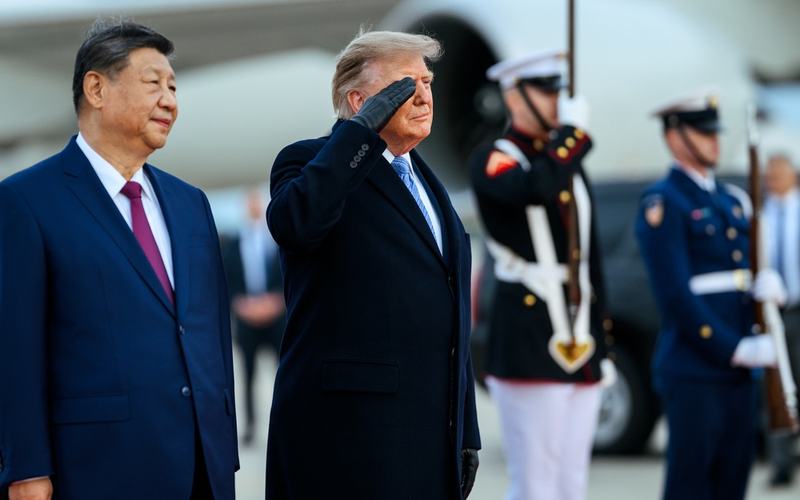
Chinese President Xi Jinping warned the United States against mishandling the Taiwan issue during talks with President Donald Trump in Shenzhen on Thursday, saying Washington must take the "right thing" approach to avoid serious damage to relations between the two countries.
The meeting, held on the sidelines of this week's Asia-Pacific Economic Cooperation summit, was described by Chinese state news agency Xinhua as "positive and constructive." The leaders also agreed to develop an action plan for what Beijing called a "constructive, strategically stable relationship."
Taiwan remains one of the most significant points of disagreement between Washington and Beijing. China claims the self-governing island as part of its territory despite opposition from Taiwan's government, and regularly conducts military operations around the island. Beijing has repeatedly demanded that the United States end arms sales to Taipei, although Xi's latest public remarks did not specifically mention the weapons agreements.
Xi described the relationship with Washington as entering a new phase, saying the two countries had established a framework based on respect, fairness and reciprocity. He also urged both governments to expand areas of cooperation while managing disagreements before they develop into larger conflicts.
"Beijing and Washington should extend the list of cooperation and shorten the list of problems," Xi told Trump, according to Xinhua. He added that disputes that cannot be resolved immediately should be handled constructively to prevent tensions from escalating.
The Shenzhen meeting marked the third encounter between Trump and Xi this year, as both governments seek to manage competition over trade, security and technology. Xi said relations had generally remained stable and on a positive trajectory, expressing his desire to maintain that momentum.
The summit also brought attention to Taiwan's participation in APEC, where the island is represented under the name Chinese Taipei rather than by its president. Taiwan's envoy, Acer founder Stan Shih, attended the gathering and shook hands with Trump and Russian President Vladimir Putin during a group photograph involving the leaders.
Shih said after returning to Taiwan that he had interacted with Trump and other international leaders and thanked countries that support deeper cooperation with Taipei. He was accompanied in Shenzhen by Vincent Chao, deputy secretary-general of Taiwan's National Security Council, marking a rare visit to China by a senior Taiwanese government official.
Beyond Taiwan, Xi called for greater cooperation between the United States and China on emerging technologies. He specifically urged the countries to strengthen communication and coordination on artificial intelligence, emphasizing the need to address safety risks and ensure the technology remains under human control.
The discussions reflect the competing priorities facing Washington and Beijing: maintaining economic and diplomatic stability while continuing to disagree over Taiwan, military security, and technological development. Xi's warning underscores that Beijing continues to view Taiwan as a central issue in determining the future of U.S.-China relations.

Comments
No comments yet. Be the first to share your thoughts.