
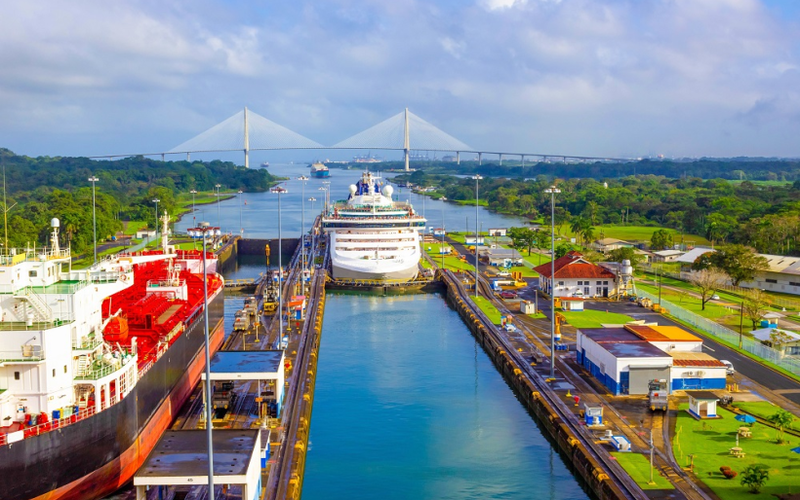
Shipping companies are reportedly paying as much as $4 million to secure expedited passage through the Panama Canal as disruptions in the Strait of Hormuz force global trade routes to shift, according to canal officials and industry estimates. The increased demand reflects growing geopolitical uncertainty that has made one of the world’s most critical maritime chokepoints increasingly difficult for commercial navigation.
Under normal operations, vessels transit the Panama Canal through scheduled reservations at standardized toll rates. However, ships without bookings can compete for earlier passage through an auction system, where the highest bidder secures available slots. In recent weeks, those auction prices have surged sharply as shipping firms reroute cargo away from the Middle East due to heightened security risks and instability in the Strait of Hormuz.
Industry officials say the shift has been driven by escalating tensions between the United States and Iran, which have contributed to heightened risks for vessels operating near the strategic waterway. As a result, more shipping companies are opting for longer or more expensive alternative routes, including transit through Panama, in an effort to avoid potential disruptions.
Ricaurte Vásquez, administrator of the Panama Canal Authority, said one unnamed fuel carrier paid an additional $4 million after changing its destination mid-route due to geopolitical developments. He also noted that several oil transport firms have paid millions in premium fees to accelerate passage as global energy markets react to supply uncertainty.
Standard transit fees through the canal typically range between $300,000 and $400,000 depending on vessel size, with earlier scheduling previously costing an additional $250,000 to $300,000. That surcharge has now increased to an average of roughly $425,000 in recent weeks, reflecting heightened competition for access.
Officials in Panama say the spike in payments is not a fixed rate but the result of companies bidding for urgency amid volatile global conditions. Vásquez said shipping firms are effectively determining how much they are willing to pay to reduce delays as supply chains face increasing strain.
Panamanian analyst Rodrigo Noriega said the situation reflects broader disruption across international trade routes, with companies prioritizing security and reliability over cost. He noted that ongoing instability in the Middle East has made alternative shipping corridors more attractive despite higher expenses.
At the same time, Panama has also been drawn into the broader geopolitical tensions affecting maritime traffic. The country’s foreign ministry recently accused Iran of seizing a Panama-flagged vessel operated by an Italian shipping company in the Strait of Hormuz, calling the incident a violation of maritime security and international navigation norms.
Energy markets have also responded to the heightened uncertainty, with Brent crude oil prices briefly rising above $107 per barrel this week, up significantly from roughly $66 a year earlier. Analysts say continued instability in key shipping lanes could further increase both transportation costs and global energy prices if disruptions persist.

Comments
No comments yet. Be the first to share your thoughts.