
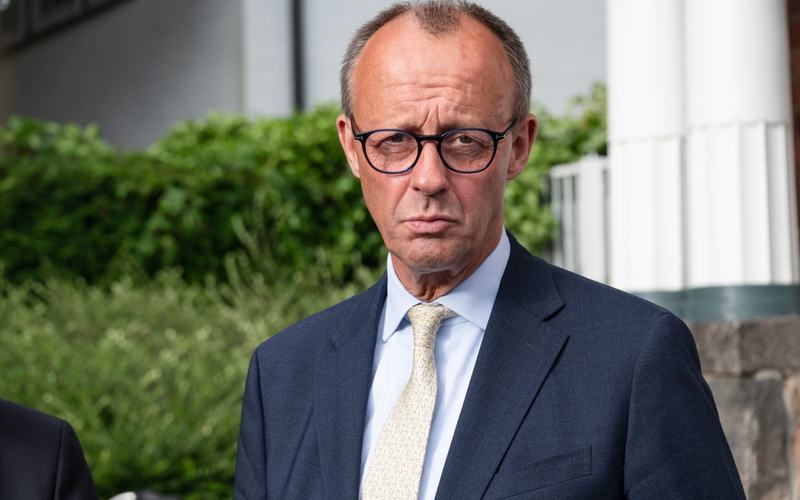
President Donald Trump sharply criticized German Chancellor Friedrich Merz on Tuesday, accusing him of believing it is acceptable for Iran to possess nuclear weapons.
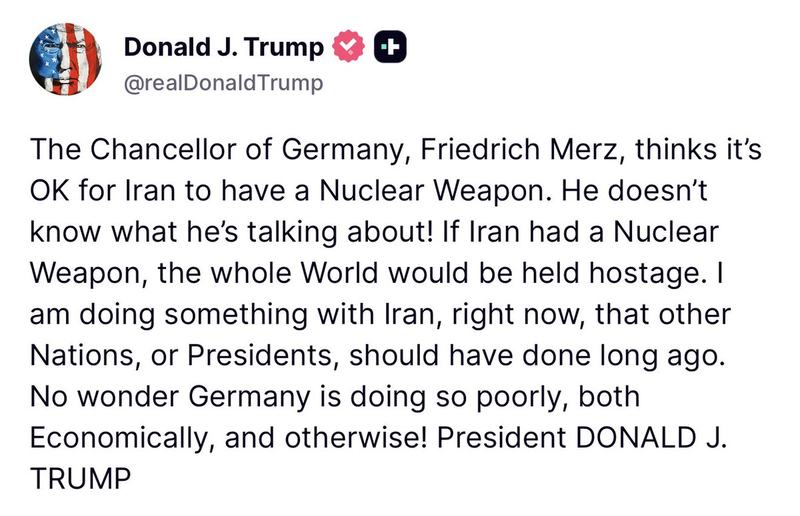
Trump made the remarks in a post on his Truth Social platform, writing: "The Chancellor of Germany, Friedrich Merz, thinks it’s OK for Iran to have a Nuclear Weapon. He doesn’t know what he’s talking about! If Iran had a Nuclear Weapon, the whole World would be held hostage. I am doing something with Iran, right now, that other Nations, or Presidents, should have done long ago. No wonder Germany is doing so poorly, both economically and otherwise!"
The outburst followed comments Merz made on Monday in which he stated that the United States was being "humiliated by the Iranian leadership" during stalled negotiations to end the ongoing war with Iran. Merz added that the Iranians were "clearly stronger than expected and the Americans clearly have no truly convincing strategy in the negotiations either." He also described the U.S.-Israeli military campaign against Iran as "ill-considered," noting the difficulty of exiting such conflicts, as demonstrated in Afghanistan and Iraq.
The exchange highlights deepening transatlantic tensions amid the war, which began with U.S. and Israeli strikes on Iran. Iran has since blockaded the Strait of Hormuz, through which about 20 percent of global oil flows, driving up energy prices and exacerbating economic pressures in Europe. European allies, including Germany, have resisted Trump's calls for greater military involvement, prioritizing a diplomatic resolution over an open-ended conflict.
Trump has repeatedly emphasized that Iran must never acquire nuclear weapons, a stance he reiterated during a White House state dinner where he claimed British King Charles agreed with him on the issue. Negotiations to lift the blockade and end hostilities have faltered, with U.S. officials traveling to Pakistan for talks but achieving no breakthroughs.
A German official, speaking anonymously, questioned the wisdom of Merz's public rebuke, warning it could widen the rift in transatlantic relations. "Part of diplomacy is not speaking every truth out loud," the official said. Merz's office did not immediately respond to requests for comment.
Merz, who became chancellor in May 2025, has previously voiced concerns about U.S. reliability under Trump, telling the Munich Security Conference in February that American leadership was "being challenged, perhaps already lost." The current spat underscores ongoing divisions between Washington and Berlin over global security challenges, including the wars in Ukraine and now Iran.

Comments
No comments yet. Be the first to share your thoughts.