
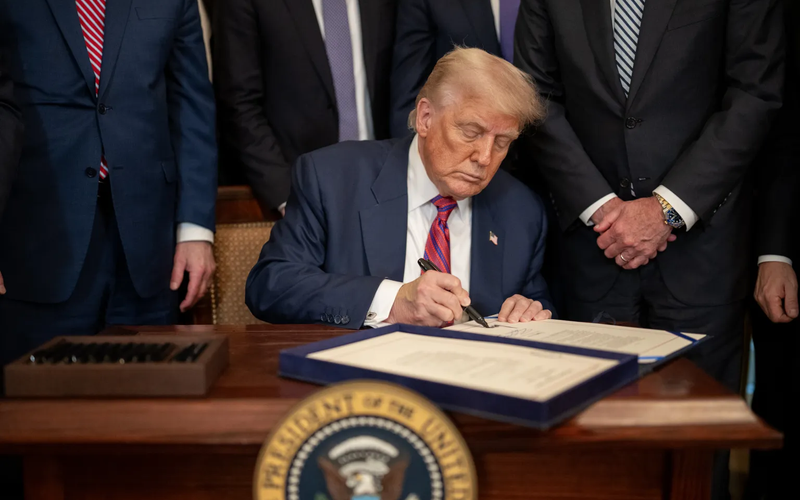
President Donald Trump has signed an executive order on artificial intelligence that establishes a voluntary framework for coordination between the federal government and AI developers, according to reporting from Politico citing White House officials.
The order was signed privately rather than in a public ceremony, a departure from how major executive actions are often announced. It revises an earlier draft that reportedly proposed a more structured pre-release review system but was withdrawn following concerns raised by industry stakeholders.
Under the finalized version, select AI companies may voluntarily submit new models to federal officials for review up to 30 days before public release. The framework is intended to facilitate information sharing on safety and security considerations without imposing mandatory approval requirements.
Earlier drafts of the policy had reportedly called for a 90-day advance review period, while industry participants had pushed for a shorter 14-day window. The final compromise reflects those competing pressures.
The executive order emphasizes that the federal government does not intend to impose regulatory barriers that could slow innovation in the rapidly evolving AI sector. It states that the United States maintains its leadership in artificial intelligence due to private-sector innovation and a policy environment that encourages technological development.
The order also highlights national security concerns tied to the rapid advancement of AI systems, directing agencies to coordinate more closely with industry to monitor risks and ensure secure deployment of emerging technologies.
Officials described the framework as a mechanism to improve cybersecurity awareness and infrastructure protection, particularly as AI systems become more widely integrated into critical sectors of the economy.
At the same time, the order explicitly states that participation in the review process is voluntary and does not create any licensing, preclearance, or mandatory approval requirements for AI development or deployment.
The administration has framed the policy as part of a broader effort to balance technological innovation with national security considerations while avoiding what it views as overly burdensome regulation that could hinder U.S. competitiveness in the global AI race.

Comments
No comments yet. Be the first to share your thoughts.