
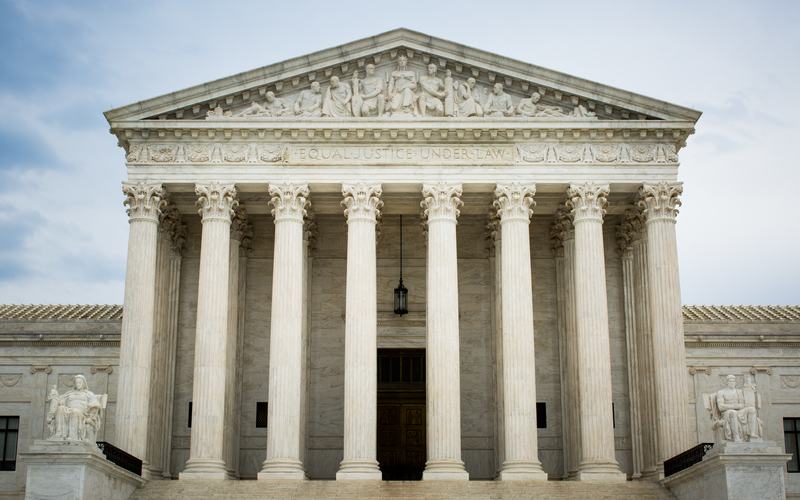
The Supreme Court on Wednesday revived a wounded Army veteran's negligence lawsuit against a defense contractor over a 2016 suicide bombing at a U.S. military base in Afghanistan.
In a 6-3 decision in Hencely v. Fluor Corp., Justice Clarence Thomas wrote for the majority that state-law tort claims against contractors are not preempted by federal law when the government neither ordered nor authorized the allegedly negligent conduct. The ruling sends the case back to the lower courts for further proceedings.
The incident occurred on Veterans Day weekend in 2016 at Bagram Airfield during a 5K race. Ahmad Nayeb, a former Taliban fighter hired by Fluor Corporation under the military's "Afghan First" program to employ locals, detonated a suicide vest after former Army Specialist Winston T. Hencely confronted him. The blast killed five people, including three U.S. soldiers and two civilians, and wounded 17 others.
Hencely, then 20 years old, suffered severe injuries, including a fractured skull, traumatic brain injury, seizures, and partial loss of function on his left side after shrapnel tore through his brain. A U.S. Army investigation concluded that Fluor's failures in supervision were the primary contributing factor, as Nayeb built the bomb on Fluor's jobsite using company tools and materials while unsupervised, violating base access protocols for Afghan workers.
Hencely sued Fluor in federal court in South Carolina, alleging negligent supervision, negligent entrustment of tools, and negligent retention under state law. The district court granted summary judgment for Fluor, and the Fourth Circuit affirmed, applying a "battlefield preemption" doctrine linked to the Federal Tort Claims Act's combatant-activities exception.
Fluor argued it shared the government's immunity because its work was integrated into wartime operations. Hencely countered that immunity applies only to the government itself and that contractors lose protection for failing contractual duties.
Thomas's opinion, joined by Justices Sotomayor, Kagan, Gorsuch, Barrett, and Jackson, rejected broad preemption. "The Fourth Circuit erred in finding Hencely’s state-law tort claims preempted where the Federal Government neither ordered nor authorized Fluor’s challenged conduct," the syllabus states. The Court held the FTCA exception shields only the government, not contractors, and precedents like Boyle v. United Technologies Corp. protect contractors only when following government specifications, not deviating from them.
Justice Alito dissented, joined by Chief Justice Roberts and Justice Kavanaugh. He argued the suit intrudes on federal war powers, as it would allow state judges to second-guess military security decisions in a war zone, including policies favoring Afghan hires.
The decision clarifies limits on contractor immunity in combat zones, potentially opening similar suits but requiring proof of negligence outside government directives. Hencely's case now returns to the Fourth Circuit.

Comments
No comments yet. Be the first to share your thoughts.