
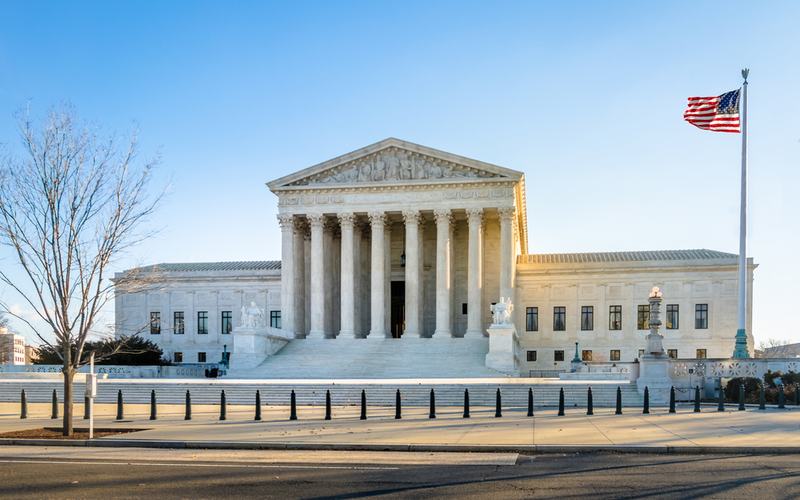
The Supreme Court on Monday temporarily restored broad access to the abortion pill Mifepristone by staying a recent federal appeals court decision that had mandated in-person dispensing.
Justice Samuel Alito issued the administrative stay on behalf of the court, putting the 5th U.S. Circuit Court of Appeals' order on hold until May 11 at 5 p.m. EDT. The move allows patients to obtain Mifepristone through telehealth consultations, mail delivery, and at pharmacies without requiring an in-person doctor's visit. Both the Food and Drug Administration and Louisiana, which brought the underlying challenge, must respond to the emergency applications by Thursday.
The emergency appeals came from Danco Laboratories, maker of the brand-name Mifeprex, and GenBioPro, producer of a generic version. They argued that the appeals court's ruling would cause immediate chaos in time-sensitive medical care and upend access nationwide.
The 5th Circuit's decision stemmed from a lawsuit filed by Louisiana in 2025. The state claimed that FDA rules allowing remote prescriptions undermined its near-total abortion ban enacted after the Supreme Court's 2022 Dobbs v. Jackson Women's Health Organization ruling, which overturned Roe v. Wade. A federal district judge in Louisiana had paused enforcement pending an FDA safety review, but the appeals court reversed that, finding Louisiana had standing and reinstating the in-person requirement nationwide.
This marks a return to the Supreme Court for Mifepristone disputes. In 2023 and 2024, U.S. District Judge Matthew Kacsmaryk and the 5th Circuit had sought to restrict the drug's availability, including rollbacks of FDA expansions from 2016 and 2021 that extended gestational limits and allowed non-physician prescribing. The Supreme Court stayed those restrictions and, in June 2024, unanimously ruled in FDA v. Alliance for Hippocratic Medicine that anti-abortion doctors lacked standing due to insufficient evidence of direct harm.
Mifepristone, used with misoprostol, accounts for more than 60 percent of U.S. abortions. FDA rules finalized in 2023 had eliminated the in-person pickup requirement, facilitating access amid state bans affecting 14 states with total prohibitions and others with gestational limits.
Reactions split along familiar lines. Kristan Hawkins, president of Students for Life of America, criticized the decision as giving 'pill pushers' the benefit of the doubt while arguments proceed. Louisiana Attorney General Liz Murrill called it temporary and expressed confidence that 'life and the law will win.' Pro-access advocates, including Dr. Angel Foster of The Massachusetts Abortion Access Project, vowed to continue providing care regardless of regulatory outcomes.
The court will now consider whether to extend the stay as it weighs Louisiana's standing claim, which drugmakers argue mirrors the attenuated theories rejected in 2024.

Comments
No comments yet. Be the first to share your thoughts.