
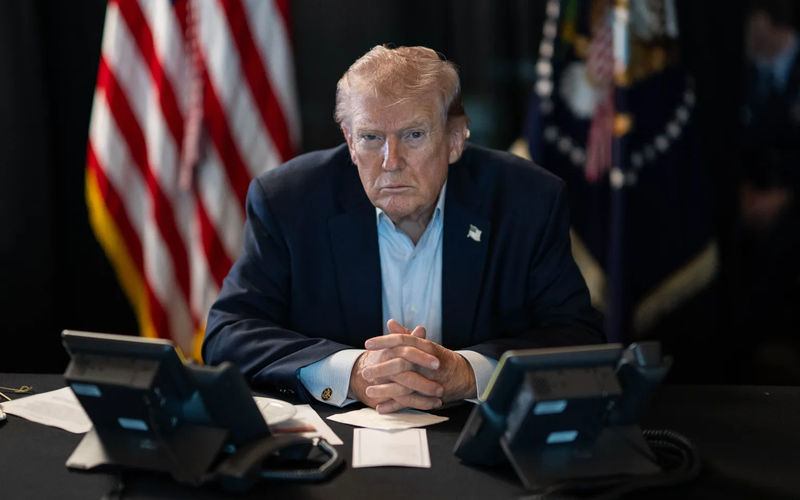
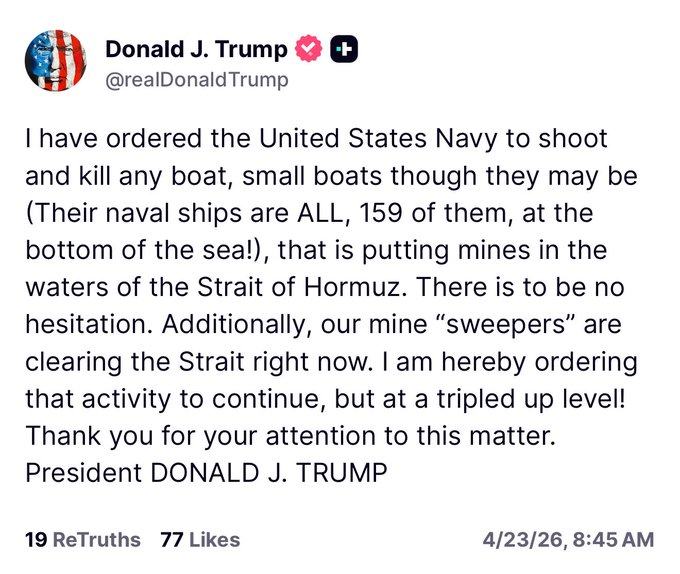
President Donald Trump announced on Thursday that he has ordered the U.S. Navy to 'shoot and kill' any Iranian small boats deploying mines in the Strait of Hormuz. The directive, posted on social media around 9 a.m. EDT, aims to counter Iran's efforts to choke traffic through the vital waterway, which carries about 20% of global seaborne oil trade.
Trump's exact words were: "I have ordered the United States Navy to shoot and kill any boat, small boats though they may be...that is putting mines in the waters of the Strait of Hormuz. There is to be no hesitation." He also instructed U.S. minesweepers to triple their efforts to clear the strait. The order comes as the U.S. maintains a naval blockade of Iranian ports imposed earlier this month, seizing vessels linked to Iranian oil smuggling, including the Guinea-flagged tanker Majestic X in the Indian Ocean on Thursday.
The Strait of Hormuz crisis erupted on February 28, 2026, when Iran closed the 34-kilometer-wide chokepoint following U.S. and Israeli airstrikes that killed Supreme Leader Ali Khamenei during Operation Epic Fury. Iran responded with missile and drone attacks on U.S. bases, Israeli targets, and commercial ships, while laying mines and using its Revolutionary Guard speedboats to attack over 30 vessels in the Persian Gulf, Strait, and Gulf of Oman. At least 17 to 20 seafarers have died in these incidents, with ships sunk, damaged, or captured.
A fragile ceasefire took hold on April 8, but collapsed amid failed talks in Islamabad mediated by Pakistan. Iran briefly announced reopening the strait on April 17 but reversed course after the U.S. blockade continued. On Wednesday, Iran's Revolutionary Guard attacked three cargo ships in the strait, capturing two. Traffic has plummeted over 90%, stranding around 2,000 ships and 20,000 mariners. Gulf oil producers like Iraq, Saudi Arabia, UAE, Qatar, Kuwait, and Bahrain declared force majeure, cutting output by about 10 million barrels per day.
Brent crude prices surged to a peak of $126 per barrel, the fastest rise on record, fueling global fuel shortages and higher costs for food, fertilizers, and other goods. Insurance premiums for strait transits jumped four to six times, and shipping firms halted operations pending safety assurances.
Iran's judiciary chief claimed U.S. forces lack the courage to enter the strait, while the Revolutionary Guard touted its 'mosquito fleet' of speedboats and drones. No immediate Iranian response came to Trump's order. Internationally, the UK rallied over 40 nations to pressure Iran to reopen the strait, India evacuated 2,680 of its seafarers, and the Pope called for peace talks. Iran's exiled Crown Prince Reza Pahlavi criticized the ceasefire approach.
As of Thursday afternoon, no reports indicated shots were fired under the new rules of engagement, but U.S. forces continued mine clearance and enforcement operations. The strait remains largely closed to traffic, with Iran selectively allowing some shipments to China, Russia, and India while charging tolls exceeding $1 million per vessel during brief openings.

Comments
No comments yet. Be the first to share your thoughts.