
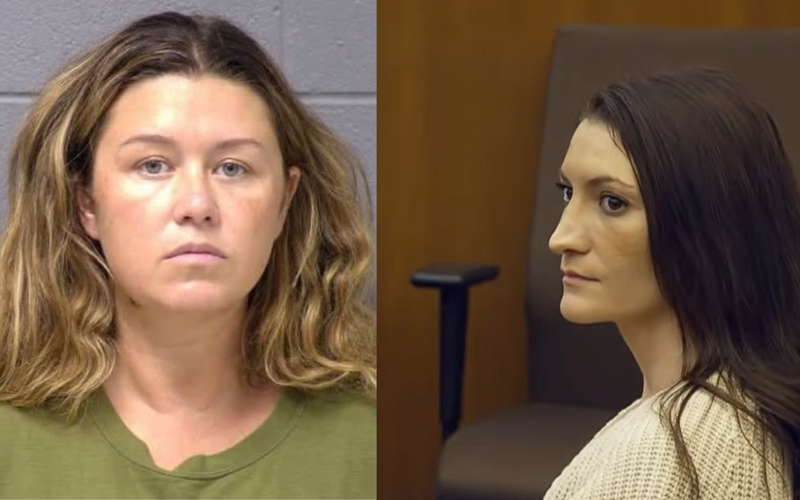
“Copycat killers” has been a popular phrase since the early 1900s. Today, the term has reappeared following the high-profile Lindsay Clancy case and a woman who allegedly mirrored her actions.
Corie Walsh, a 38-year-old suburban Chicago woman, was charged with killing her 2-year-old toddler son, Barrett, after witnesses and police found him hanging inside the family’s Frankfort home.
Walsh was arrested in early September, after police responded to an injured child call on Brook Stone Court. According to the Frankfort Police Department, a neighbor found the boy, identified as Walsh's son Barrett, hanging from a rafter in the basement and began performing CPR after removing the ligature. The child was taken to a hospital but was pronounced dead.
Walsh was also found inside the home attempting to harm herself. Officers discovered her in a bathtub with cuts to her wrists and thighs. She was taken to a hospital for treatment, and her injuries were described as non-life-threatening.
While being interviewed by law enforcement, Walsh told investigators she killed him because she believed he was the "devil" and the "anti-Christ." Witnesses said she had recently become fixated on the Lindsay Clancy trial, raising concerns that her actions were a response to Clancy’s and lending credence to the copycat claims.
They added that Walsh would actively discuss the trial with friends in a group text, sending messages related to Clancy just hours before the discovery of her son.
Clancy, a former labor and delivery nurse, stands accused of killing her three children. The case gained national attention due to discussions centered on whether she was criminally responsible, with the defense arguing she suffered from postpartum psychosis and was overmedicated at the time. The prosecutors have refuted this narrative and maintained that she acted with intent.
Clancy’s case ended in a mistrial on September 4 after the jury reported for a third time that it could not reach a unanimous verdict, meaning she will remain held at a psychiatric facility pending further proceedings.
Since Walsh has been relegated to a copycat killer, one wonders how the term came into existence, and if there are other instances of people mirroring the actions of famous killers.
Where Did the Phrase “Copycat Killer” Come From?
The first recognized example came in 1912, when public fascination with Jack the Ripper inspired other killers to commit similar crimes.
In regard to the London killer, two men famously attributed their crimes to Jack the Ripper, citing inspiration from their actions.
Peter Sutcliffe, known as the Yorkshire Ripper, killed at least 13 women in the 1970s and 1980s. Derek Brown, convicted in 2008, perpetrated two murders that echoed the original Ripper's methods.
Another example comes from the 1999 Columbine High School massacre, which killed 13 and injured 24 others in Littleton, Colorado. The massacre has led to more than 40 charged plots and numerous attacks explicitly linked to the event, according to investigations by CNN and ABC News.
The incident spawned the term “Columbine Effect”, which instilled stricter security measures in education facilities such as transparent backpacks, metal detectors, school uniforms, and security guards. This effect has also led to nearly 74 cases where plotters cited the Columbine High School shooting as inspiration. According to the media outlet Mother Jones, law enforcement thwarted 53 of the reported 74 cases; however, 21 attacks occurred.
In at least 10 cases, the suspects and attackers referred to the pair who struck in 1999, Eric Harris and Dylan Klebold, as heroes, idols, martyrs, or God.
The first reported incident of a Columbine copycat killer may have been the W. R. Myers High School shooting, just eight days after Columbine, when a 14-year-old Canadian student went into his former school in Taber, Alberta, at lunchtime with a sawed-off .22 rifle under his dark blue trench coat and opened fire, killing one student. Today, over 300 deaths have been attributed to Columbine-inspired incidents worldwide.
Media portrayals have also played a role in some cases. The film Natural Born Killers was cited in the 1995 crime spree by Sarah Edmondson and Benjamin Darras, who killed one man and paralyzed another. Another killer, Mark Twitchell, cited inspiration from the television series Dexter in his 2008 murder in Canada.
The issue even transcends into the world of fiction, as an attempted copycat killing based on the mythical internet horror character Slenderman saw two 12-year-olds lure a sixth-grade classmate into the woods, where they tried to sacrifice the child to appease the aforementioned Slenderman.
Morgan Geyser and Anissa Weier coaxed their victim into the park under the pretense of a friendly game of hide-and-seek, only to stab the sixth grader 20 times before leaving her for dead. The victim dragged herself from the woods and flagged down a passerby, who then called 911. She miraculously survived the near-fatal stabbing, doctors later noting that one of the stab wounds was just one millimeter away from piercing an artery, The New York Times reported.
Many attribute the rise of the copycat killer to the public’s exposure to media, especially movies and video games, which glamorize the actions for impressionable individuals.
Although the idea of what causes a copycat killer cannot be isolated to one factor, in a study done by Raymond Surette, a professor of criminal justice at the University of Central Florida and an expert in copycat crime, in which he surveyed 574 inmates about their criminal behavior, 22% of the incarcerated people admitted to having committed a copycat crime; one out of five of these crimes was violent.
Surette found men were more likely than women to commit a copycat crime, typically inspired by a real-world crime, such as that committed by a friend or a relative.
One can attribute Walsh’s alleged killing to a factor of mental health, similar to Clancy, hence the comparison.
However, the copycat phenomenon will remain relevant in popular culture whenever horrific actions are put on display for the public to digest.
While it cannot be said outright that Walsh intended to copy Clancy’s alleged crimes, concerns have been raised about the movement supporting Clancy.
Supporters have flooded the Musgrove Family Fund, a GoFundMe campaign for Lindsay Clancy's parents, with donations totaling more than $1.12 million. Critics said supporters who pledged money to the campaign are co-opting it to show their allegiance to Lindsay Clancy.
Like Clancy, Walsh’s family created a GoFundMe campaign with a $100,000 goal. GoFundMe paused the donation page after the campaign reached just over $37,000.
A statement by the “Friends of Walsh Family for Ryan Walsh” reads:
"Your generosity will directly support Mike with the kids' immediate needs- covering everyday essentials like groceries, childcare support, and extracurricular activities that can bring a sense of stability, joy, and routine back into their daily lives. Every contribution, no matter the size, helps ease the burden on their family and gives these three sweet children the resources and care they need right now."
Walsh remains in custody while receiving medical treatment. Prosecutors are seeking to have her held without pretrial release, and investigators are continuing to examine evidence, including her cellphone.

Comments
No comments yet. Be the first to share your thoughts.