
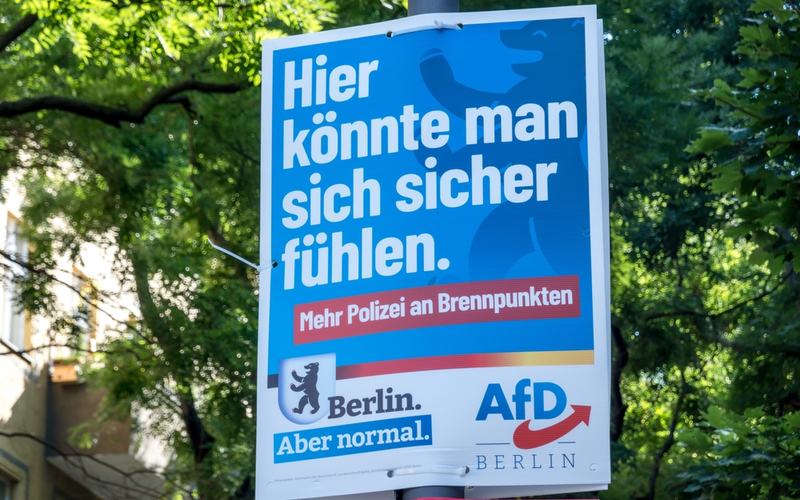
Germany’s Alternative for Germany (AfD) has reached a new high in national polling following strong performances in recent state elections, while the governing Christian Democratic Union (CDU) has struggled to maintain its support.
An INSA survey conducted Sept. 18-21 found the AfD at 29.5%, its highest recorded level in the pollster’s tracking. The CDU/CSU stood at 19.5%, leaving the AfD 10 percentage points ahead.
The numbers came shortly after the AfD recorded strong results in state elections in eastern Germany. In Mecklenburg-Western Pomerania, the party received 37% in an exit poll, narrowly ahead of the Social Democrats at 35.5%, while the CDU received just 5.5%.
The party’s support is also showing signs of expanding into western Germany. A Forsa poll of 1,030 eligible voters in North Rhine-Westphalia conducted Sept. 7-18 placed the AfD at 24% on a federal-election question, compared with 22% for the CDU. It was the first time Forsa recorded the AfD ahead of the CDU in the state on a national voting question.
North Rhine-Westphalia is Germany’s most populous state and is home to roughly 18 million people. The state has traditionally been an important base for both the CDU and Social Democratic Party, making the AfD’s showing there notable as the party attempts to broaden its support beyond eastern Germany.
The NRW poll also showed the Greens at 18%, the SPD at 14%, the Left at 12% and the Free Democratic Party at 3%. On a separate question concerning a state election, the CDU remained ahead of the AfD, 29% to 22%, indicating that the two measures produced different results.
The polling comes amid growing scrutiny of Chancellor Friedrich Merz and his CDU. In North Rhine-Westphalia, only 11% of those surveyed said they were satisfied with Merz's performance, while 87% expressed dissatisfaction, according to the same polling reported by Brussels Signal.
The broader national polling picture similarly shows the AfD maintaining a substantial lead over the CDU/CSU. Other surveys released later in September have placed the AfD between 28% and 29%, while the CDU/CSU has ranged from 21% to 23%, according to polling compilations.
Despite the AfD’s polling gains, the party remains excluded from governing coalitions by Germany’s other major parties. The current figures therefore measure voter support rather than indicating that the AfD would automatically enter government.
The shift marks a broader change in Germany’s political landscape, with the AfD now registering significant support in both eastern and western states while the CDU faces pressure over its standing under Merz.

Comments
No comments yet. Be the first to share your thoughts.