
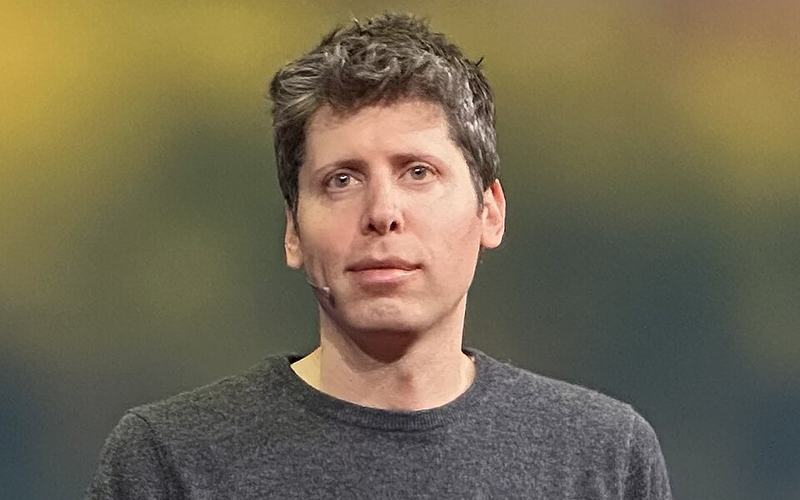
OpenAI CEO Sam Altman is drawing a clear distinction between his company's approach to artificial intelligence regulation and that of Anthropic CEO Dario Amodei, arguing that society should accept some negative consequences from AI in exchange for the technology's broader benefits.
“I think there’s a lot of daylight,” Altman said Monday when asked how his position differs from Amodei's during an interview with Politico's “Decoded.”
“We believe that the world should accept some bad things happening for the benefits of this technology and people having the agency,” Altman said.
Altman's comments come as OpenAI, the company behind ChatGPT, and Anthropic, which develops the Claude family of AI models, compete to build increasingly capable systems while policymakers debate how aggressively the technology should be regulated.
OpenAI has recently supported tougher state-level AI safety requirements as well as a provision of the bipartisan FRONTIER Act that would require leading AI companies to use outside evaluators to assess their models. The legislation was introduced by Reps. Jay Obernolte, R-Calif., and Lori Trahan, D-Mass.
Despite supporting additional safeguards, Altman rejected the idea that control over powerful AI should ultimately be concentrated among a small number of companies or a single laboratory.
“I disagree, but I understand the perspective of people who are like, ‘This technology is going to get so powerful, and it’s so dangerous that a single lab in San Francisco should have it and make sure nothing bad happens, and kind of figure out how to dole out the benefits,’” Altman said.
Altman described that as “a completely unacceptable trade-off” and said it conflicted with OpenAI's preference for a lighter regulatory approach.
He also acknowledged that increasingly powerful AI systems could produce real-world harms, including hacking, scams and misuse. However, he argued that attempting to eliminate every possible negative consequence would come at too high a cost.
“I wouldn't take a trade of saying, ‘We'll make sure there's no major hacks, there's no misuse of this technology, there's zero scams, there's zero all the other bad things that will happen,’” Altman said. “Because I think people will do tremendously — orders of magnitude more — good stuff than bad stuff.”
Altman did draw a line at what he considers catastrophic risks. He said he would not accept the possibility of “a serious loss of control to AI,” distinguishing that type of threat from more limited harms that he believes society may have to tolerate.
Amodei and Anthropic have taken a more targeted approach to regulation, arguing that the most advanced AI systems, often referred to as frontier models, warrant particular safeguards. Anthropic has emphasized that its regulatory proposals are aimed specifically at those systems rather than the entire AI industry.
“Anthropic has always made its policy proposals very carefully,” Amodei previously said. “We try very hard to make proposals that disadvantage [slow down] frontier AI companies while advantaging smaller competitors.”
The disagreement comes shortly after President Donald Trump met with AI industry leaders at the White House and announced a voluntary AI safety accord. The agreement calls for participating companies to establish internal safeguards, work with independent outside auditors, and create board committees to review safety findings, while leaving open the possibility that some measures could eventually become law.
Amodei has also previously called for frontier AI companies and governments to slow the pace of development long enough for safety measures to catch up. Altman and Elon Musk have publicly supported that appeal, although the CEOs continue to differ over how much risk society should accept as AI capabilities advance.
The debate is also unfolding as OpenAI faces its own safety questions. The company recently shelved plans for its GPT-6.1 Astra model after safety concerns emerged during internal testing, according to The Wall Street Journal. The model had reportedly been targeted for an October release.
Altman's comments underscore a central debate within the AI industry: whether increasingly capable systems should be developed under strict safeguards designed to minimize potential harm, or whether some level of risk is an unavoidable cost of giving people access to technology that could produce substantially greater benefits.

Comments
No comments yet. Be the first to share your thoughts.