
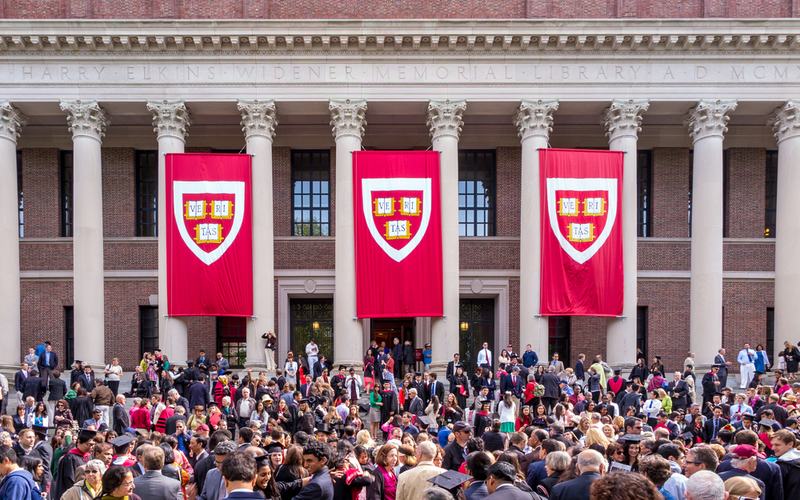
Asian-American students accounted for a record 43.2% of Harvard University’s incoming freshman class, more than double their share when a legal challenge accused the Ivy League school of discriminating against Asian-American applicants, according to figures reported by The Washington Free Beacon.
Edward Blum, president of Students for Fair Admissions, the organization behind the lawsuit against Harvard, said the increase provides evidence that race played a significant role in the university’s admissions decisions for years.
“In 2014, the year Students for Fair Admissions sued Harvard, Asian-American students accounted for approximately 19% of its entering freshman class,” Blum told the Free Beacon.
The enrollment figures have drawn renewed attention following the Supreme Court’s 2023 decision against Harvard’s use of race in admissions. Since the ruling, the share of Black and Hispanic students in Harvard’s incoming classes has declined, while Asian-American enrollment has increased.
Blum described the latest figures as “powerful evidence that Harvard used race as a primary factor in its admission decisions for decades.”
The reported 43.2% figure may not capture the full share of Asian students at Harvard. According to the Free Beacon, the university’s figure includes U.S. citizens and permanent residents who chose to disclose their race or ethnicity. It may exclude students who did not answer the question, as well as some international students, who account for approximately 15% of the incoming class.
The university has also faced criticism over the availability of its admissions data. The Free Beacon reported that Harvard does not routinely disclose the racial composition of its applicant pool, information that became available during the litigation brought by Students for Fair Admissions.
Harvard is now resisting efforts by the Justice Department to obtain admissions records as part of a lawsuit seeking to determine whether the university is complying with federal law following the Supreme Court’s decision.
“The Supreme Court’s decision in 2023 didn’t require Harvard to admit more Asian-American students or fewer whites, Blacks and Hispanics. It required Harvard to stop discriminating by race. The results speak for themselves,” Blum said.
He also called on Congress to require colleges and universities to disclose admissions data broken down by race and academic qualifications.
“Only this kind of empirical transparency will reveal whether universities are truly complying with the law,” Blum added.
Republicans in the House and Senate are supporting the College Admissions Accountability Act, legislation that would establish a special inspector general with investigative authority to examine potential unlawful discrimination in higher education.
Harvard’s enrollment figures also stand out in comparison with other selective universities. Stanford University reported that Asian students made up 31% of its incoming class in fall 2025, while Yale University and Princeton University reported Asian-American enrollment of 27% and 23%, respectively, for their classes of 2030.
The Massachusetts Institute of Technology reported that Asian-American students accounted for 38% of its class of 2029. MIT does not give admissions preference to the children of alumni.
The figures do not, by themselves, establish whether Harvard has complied with the Supreme Court’s ruling. However, the increase in Asian-American enrollment has intensified calls for greater transparency into how selective universities evaluate applicants and whether admissions decisions are being made without unlawful racial preferences.

Comments
No comments yet. Be the first to share your thoughts.