
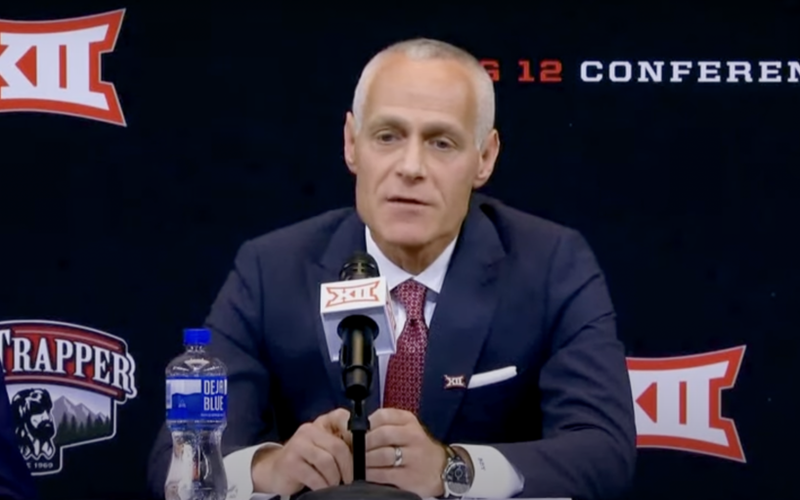
Big 12 Commissioner Brett Yormark is preparing to leave the conference for a new position outside college athletics, ending a tenure that saw the league navigate major realignment, add eight schools, and secure a critical television deal.
Yormark approached Big 12 leadership about his decision nearly 10 days ago, according to Kansas Chancellor Doug Girod, who chairs the conference's board of directors. The two sides discussed his departure in recent days before the board formally approved the terms Friday morning.
"He approached us with a proposal to craft a path for what you'd call an 'elegant exit,'" Girod told ESPN.
Yormark plans to remain in the position through January 2027 to help ensure a smooth transition. The conference will launch a national search for its sixth commissioner. Yormark became the league's fifth commissioner when he replaced Bob Bowlsby in 2022.
In a statement, Yormark said he believes he is leaving the conference in a strong position.
"When I accepted this job, my goal was to put this conference on an upward trajectory and truly believe that the future of the conference could not be in better shape," Yormark said. "The next commissioner of this league will inherit a conference that is 16 strong. There has never been a better time to be a member of the Big 12 than right now."
Girod credited Yormark's leadership with helping the Big 12 avoid the problems that ultimately dismantled the Pac-12. One of Yormark's earliest major decisions was persuading conference leaders to pursue an early television agreement rather than wait for the existing deal to expire.
The move resulted in a new agreement with ESPN and Fox that helped secure the Big 12's financial and competitive future as college athletics underwent major realignment.
"I think in all fairness, had he not joined us and convinced us to go early on redoing our television deal, we all believe we could have ended up as the Pac-12 did," Girod told ESPN. "As it played out, it demonstrated it was the right move. His leadership, experience and network in the media world have continued to be extremely beneficial for us."
Yormark also oversaw the integration of eight new members into the conference. BYU, Cincinnati, Houston and UCF joined before his arrival, while Colorado, Arizona, Arizona State and Utah formally entered the league in 2023 after the Pac-12's collapse accelerated the reshaping of college sports.
Girod said bringing those schools together with the conference's eight established members was a significant undertaking.
"He's helped us integrate eight teams and build a strong culture with eight new folks along with the legacy eight," Girod said. "That was no small undertaking either."
Yormark's background was outside traditional college athletics. Before joining the Big 12, he served as chief operating officer of Roc Nation, with experience in professional sports and brand development that conference leaders believed could help modernize the league.
"We felt that we needed not the traditional former athletic director kind of leader," Girod said. "We needed someone who innovated in this space and built brands in very strong ways."
Yormark brought an aggressive approach to conference growth, including an unsuccessful effort to add UConn. Girod said the commissioner's pace sometimes required conference leadership to slow him down.
"Just his fire and his drive, we had to slow him down a little bit because we didn't move that fast," Girod said.
The Big 12 has also strengthened its position in men's basketball during Yormark's tenure. Houston reached the national championship game in 2025, while Arizona advanced to the Final Four in 2026. Yormark frequently promoted the conference as the nation's second-best basketball league behind the NBA.
The conference extended Yormark's contract through 2030 in May 2025, but Girod suggested the commissioner believed it was time for a new challenge.
"I think he thought he had one good run left in him," Girod said. "He had to decide whether to do it with us or someone else."
Girod said the conference will approach the search for a successor with an open mind. He indicated that Big 12 leaders want an innovative candidate who understands university campuses and can continue developing new revenue streams as the business of college athletics changes.
"I'm going in very open-minded," Girod said. "I don't need a [Yormark] twin. I need someone who hopefully has some experience with campuses, and mostly is going to be an innovator and help us on that path of revenue diversification and thinking differently about how we conduct ourselves and be the tip of the spear in some of these changes."

Comments
No comments yet. Be the first to share your thoughts.