
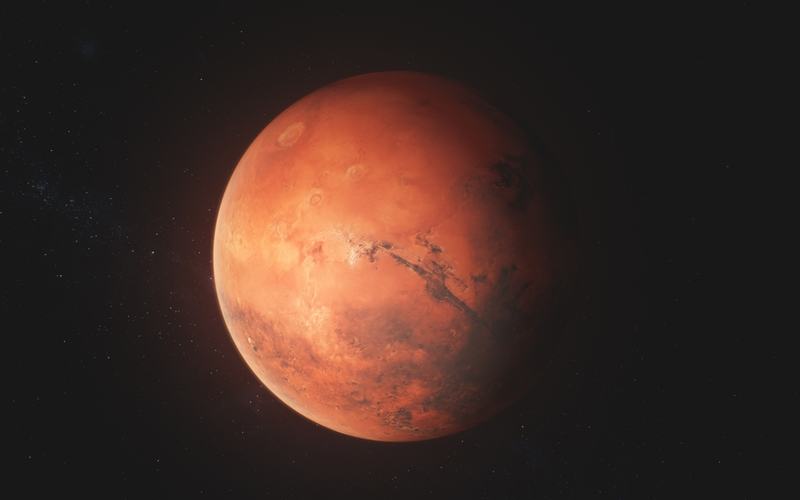
Chinese scientists have developed a prototype system to extract oxygen from Mars's carbon dioxide-rich atmosphere, potentially reducing the amount of life-support supplies future astronauts would need to transport from Earth.
The technology, developed by researchers affiliated with China’s Deep Space Exploration Laboratory, uses a process called electron cyclotron resonance (ECR) low-temperature plasma catalysis. The system uses microwaves to break down carbon dioxide into oxygen and carbon monoxide.
In laboratory testing, the prototype converted more than 50% of the carbon dioxide fed into it, exceeding the approximate 50% efficiency ceiling associated with conventional approaches, according to research published in the Journal of Deep Space Exploration.
One of the system's notable features is that it operates at room temperature, unlike NASA's MOXIE experiment aboard the Perseverance rover, which heated Martian atmospheric gases to approximately 800 degrees Celsius (1,470 degrees Fahrenheit) to produce oxygen.
The Chinese prototype also uses a compact reaction chamber approximately 49 millimeters wide, roughly the size of a golf ball. Researchers designed a specialized resonant chamber and ceramic window to direct microwaves into the reaction space, allowing the system to operate with relatively low power consumption.
Mars presents a potentially valuable source of raw material for the technology. Approximately 95% to 96% of the planet's atmosphere consists of carbon dioxide, making it an abundant resource that could be converted into oxygen rather than relying entirely on supplies shipped from Earth.
Producing oxygen on Mars could serve two major purposes: providing breathable air for astronauts and supplying oxygen needed for rocket propellant. Establishing the ability to manufacture these resources locally could reduce the cost and logistical challenges of future crewed missions.
However, the prototype is not yet ready for use by astronauts. Researchers said additional testing is needed to measure its full oxygen output and power consumption, evaluate its performance using simulated Martian atmospheric conditions, integrate it with solar power, and develop equipment to collect the resulting oxygen.
The development represents another effort to advance in-situ resource utilization, a strategy focused on using materials already available on other worlds to support long-term exploration.
NASA previously demonstrated that carbon dioxide from Mars' atmosphere could be converted into oxygen through its MOXIE experiment. The instrument aboard Perseverance produced oxygen during tests on the planet, establishing an important early step toward developing life-support systems for future human missions.
The Chinese team's research could offer another approach, particularly if its lower-temperature process can be scaled up and operated reliably under actual Martian conditions.

Comments
No comments yet. Be the first to share your thoughts.