
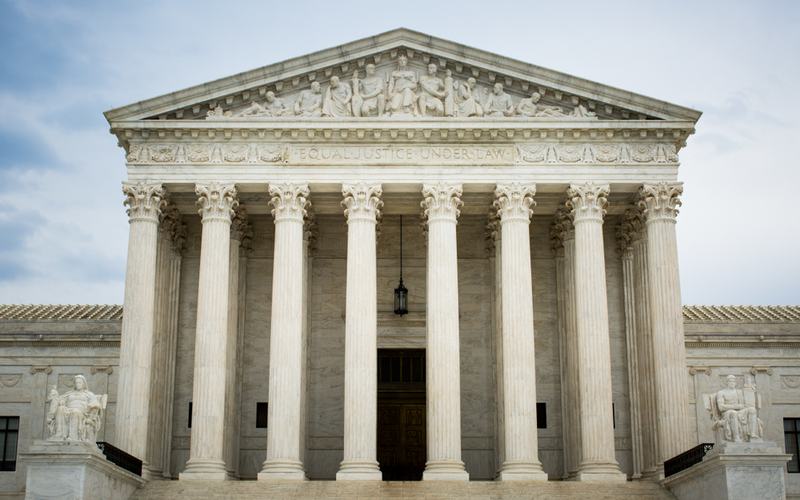
A disputed historical phrase in a landmark Supreme Court gun-rights ruling has become central to legal challenges against firearm restrictions and could influence the court's upcoming review of assault weapons bans in Illinois and Connecticut.
The controversy dates to the Supreme Court's 2008 decision in District of Columbia v. Heller, written by the late Justice Antonin Scalia. The ruling recognized an individual's constitutional right to possess firearms independently of service in a militia, while also affirming that the Second Amendment permits certain restrictions.
In explaining the limits of that right, Scalia cited a historical tradition of prohibiting the carrying of “dangerous and unusual weapons,” referencing English jurist Sir William Blackstone's 1769 Commentaries on the Laws of England. However, Blackstone's original text used the word “or” rather than “and,” describing weapons as “dangerous or unusual.”
The distinction could affect whether governments can restrict firearms that are considered dangerous but are also widely owned. Gun-rights advocates argue that weapons in common use cannot be classified as unusual and therefore should not be prohibited under the standard established in Heller.
The issue has gained renewed attention ahead of the Supreme Court's scheduled December 2 arguments over assault weapons bans in Illinois and Connecticut. Gun-rights groups have cited the dangerous and unusual standard in at least 14 legal briefs related to the cases, according to The New York Times. Some argue that the widespread ownership of AR-15-style rifles makes them too common to qualify as unusual.
The wording has also influenced other Supreme Court opinions. In a 2016 concurrence in Caetano v. Massachusetts, Justice Samuel Alito, joined by Justice Clarence Thomas, wrote that a weapon could not be banned unless it was both dangerous and unusual.
However, federal judges have disagreed over how the historical language should be interpreted. A 2025 federal appeals court opinion upholding Connecticut's assault weapons ban questioned whether the possible misquotation of Blackstone justified requiring weapons to meet both conditions before restrictions could be imposed. The opinion argued that the historical phrase could instead refer to unusually dangerous weapons.
The New York Times identified at least 98 civil court opinions applying the Heller standard since 2008. Of those, 68 upheld restrictions, 20 struck them down, and seven invalidated portions of the challenged laws, with the remaining cases still pending.
Saul Cornell, a Fordham University history professor and Second Amendment scholar, told the newspaper that the wording must be understood in the context of how historical writers used the terminology. He argued that Blackstone's phrase “dangerous or unusual” is best understood as referring to unusually dangerous weapons.
The Supreme Court's upcoming review could further clarify how the dangerous-and-unusual standard applies to modern firearms and whether common ownership is sufficient to protect a weapon from government restrictions.

Comments
No comments yet. Be the first to share your thoughts.