
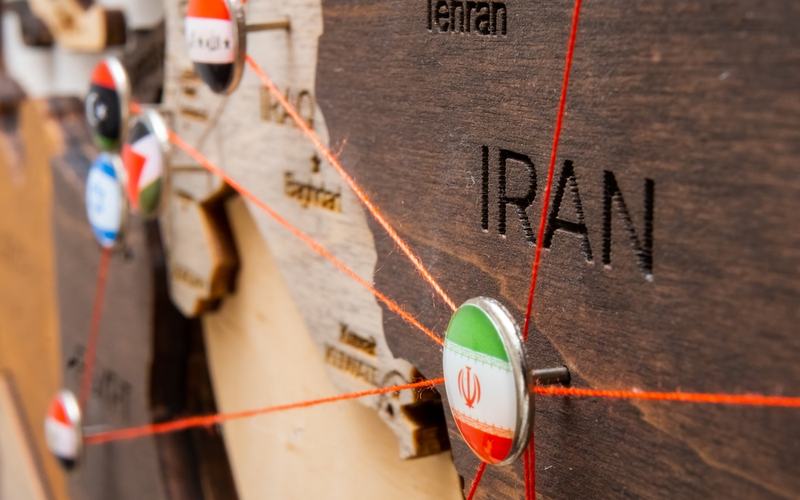
Iranian hardliners are increasingly calling for the country to develop nuclear weapons and withdraw from the Nuclear Non-Proliferation Treaty (NPT) following devastating U.S. and Israeli military strikes, according to a Monday report by the Financial Times. The growing demands signal a shift in Tehran's nuclear debate, where supporters of an atomic arsenal argue that conventional military capabilities have failed to deter foreign attacks.
The debate has intensified since the February 28 killing of Supreme Leader Ayatollah Ali Khamenei, who maintained that developing nuclear weapons violated Islamic law. His son and successor, Mojtaba Khamenei, has not publicly reaffirmed that religious prohibition, creating an opening for hardline politicians, lawmakers and analysts to argue that nuclear weapons are necessary to protect the Islamic Republic.
"The latest military confrontations showed that achieving nuclear weapons for Iran is not an ambition, but a necessity more important than bread," Davoud Modarresian, a political activist close to Iranian hardliners, wrote this month.
According to the Financial Times, some regime insiders believe the war has fundamentally changed attitudes toward acquiring nuclear weapons. One insider claimed support among Iranian officials had surged from virtually zero to more than 50%, although that figure was not independently verified.
Hassan Ghashghavi, a spokesperson for Iran's parliamentary National Security Committee, suggested last month that the new supreme leader could reverse his father's religious ruling. Ghashghavi said nobody could prevent Mojtaba Khamenei from issuing a different religious judgment.
Hardliners argue that an Iranian nuclear arsenal could deter future U.S. and Israeli attacks, pointing to North Korea as an example of a country whose nuclear capabilities complicate foreign military intervention. Abolfazl Bazargan, an international relations analyst close to hardliners, told the Islamic Revolutionary Guard Corps-affiliated Tasnim news agency that permanently ruling out nuclear weapons would amount to "self-defeat."
Bazargan proposed a nuclear doctrine that would rule out launching a first strike while preserving Iran's ability to retaliate against a nuclear attack. Such an approach would still represent a major departure from Tehran's longstanding public position that its nuclear program is intended for peaceful purposes.
The debate comes amid a continuing confrontation between Washington and Tehran over Iran's nuclear activities and control of the Strait of Hormuz. President Donald Trump has repeatedly warned Iran against rebuilding its nuclear capabilities and has demanded that the regime surrender its highly enriched uranium and abandon any pursuit of nuclear weapons.
Iran's nuclear infrastructure suffered extensive damage during U.S. strikes on Natanz, Fordow and Isfahan in June 2025, with further military confrontations this year deepening uncertainty over the program's future. Of particular concern is an estimated stockpile of approximately 440 kilograms of uranium enriched to 60% purity. If further enriched, that material could theoretically provide enough uranium for roughly 10 nuclear weapons, although producing actual weapons would require additional technical steps. The stockpile is believed to remain buried beneath damaged nuclear facilities.
Tehran has resisted Washington's demands, but Iranian officials have indicated they could consider diluting the uranium stockpile in exchange for sanctions relief and the release of frozen Iranian funds. Such a proposal would offer a possible negotiating path without requiring Iran to immediately abandon its nuclear infrastructure.
Despite the increasingly aggressive rhetoric from hardliners, Iran continues to publicly maintain that its nuclear program is peaceful. Mohammad Eslami, the country's top nuclear official, said Sunday that Tehran remains committed to plans to generate 20,000 megawatts of nuclear electricity despite the war.
Some reformist figures have also warned that pursuing nuclear weapons could put Iran's future at risk. Hossein Marashi, a senior reformist politician, argued that protecting Iran and the Islamic Republic was more important than preserving uranium enrichment capabilities.
Ali Vaez, an Iran expert at the International Crisis Group, told the Financial Times that the question of acquiring nuclear weapons has become a more serious subject of debate since the elder Khamenei's death.
"It's a serious debate and is no longer a taboo due to the former supreme leader's fatwa," Vaez said. "The war has strengthened those who argue that a country exposed to existential attack ultimately needs the ultimate deterrent."
Vaez cautioned, however, that Iran's leaders could ultimately choose to preserve the remaining nuclear infrastructure as leverage in future negotiations rather than openly pursue an atomic bomb. Maintaining that option could give Tehran bargaining power without immediately triggering the consequences of a declared weapons program.
Another possibility under discussion is withdrawal from the Nuclear Non-Proliferation Treaty, the international agreement intended to prevent the spread of nuclear weapons. A withdrawal would require Iran to provide three months' notice to other treaty members and the United Nations Security Council, further escalating tensions with Washington and raising international concerns about Tehran's intentions.
Two senior Iranian officials told the Financial Times that leaving the treaty was not currently a priority, though they declined to rule it out. One official said, "Our policy regarding the NPT has not changed yet, but this doesn't mean it won't in the future."
The growing debate leaves Iran's leadership facing a consequential choice: retain its remaining nuclear capabilities as a negotiating tool, or move toward a weapons program that could further isolate the country and intensify the risk of another military confrontation.

Comments
No comments yet. Be the first to share your thoughts.