
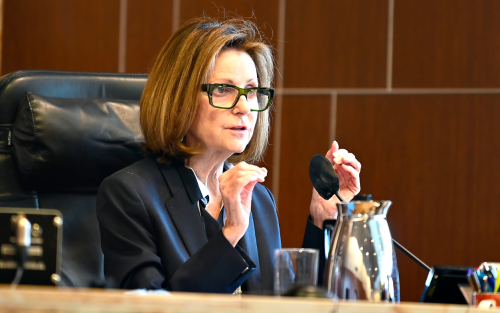
A federal judge expressed deep skepticism Friday about President Donald Trump's $10 billion lawsuit against the Internal Revenue Service and Treasury Department, ordering both sides to justify why the case should proceed.
U.S. District Judge Kathleen M. Williams, an Obama appointee in Miami's federal court, issued a four-page order on April 24, 2026, questioning the constitutional requirement for a "case or controversy." She noted that Trump, as the sitting president, oversees the defendant agencies, potentially undermining the necessary adversity between parties.
"Although President Trump avers that he is bringing this lawsuit in his personal capacity, he is the sitting president and his named adversaries are entities whose decisions are subject to his direction," Williams wrote. She added that this setup "raises questions over whether the Parties here are truly antagonistic to each other."
The judge referenced Trump's own remarks from January 2026 aboard Air Force One, where he described the suit's dynamic as "very interesting" and suggested donating potential winnings to charity. Williams also cited a February 2025 executive order by Trump reinforcing unitary executive theory, which bars executive branch employees from advancing legal positions opposing the president's views.
Trump, his sons Donald Jr. and Eric, and the Trump Organization filed the suit in January 2026 in the U.S. District Court for the Southern District of Florida. It stems from a 2020 leak of their tax returns by IRS contractor Charles Littlejohn, who pleaded guilty in 2023 and received a five-year prison sentence in January 2024.
Littlejohn, working for Booz Allen Hamilton, disclosed Trump's returns and those of other wealthy individuals to news outlets, including The New York Times and ProPublica. The leaks revealed Trump paid $750 in federal income taxes in 2016 and 2017. Trump's filing alleges the IRS failed to prevent the breach through inadequate security and screening, causing reputational and financial harm.
A Trump spokesperson said the president "continues to hold those who wrong America and Americans accountable." The Justice Department, defending the IRS, did not immediately comment on the order.
Williams denied a joint request from both sides for a 90-day stay to pursue settlement talks but scheduled briefs due May 20 and a hearing on May 27 to address the adverseness issue. Legal experts have called the scenario unusual, given the president's control over the executive branch.

Comments
No comments yet. Be the first to share your thoughts.