
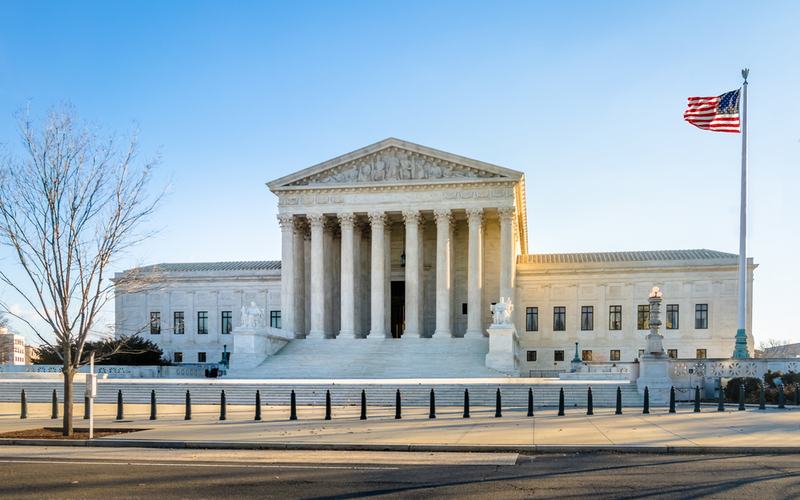
The U.S. Supreme Court will hear oral arguments on Monday in Chatrie v. United States, a case challenging the constitutionality of geofence warrants under the Fourth Amendment.
On May 20, 2019, an armed robber stole $195,000 from a federal credit union in Midlothian, Virginia, a suburb of Richmond. Surveillance video showed the robber speaking on a cellphone as he entered the bank. Investigators turned to Google for location data from devices near the scene.
Police obtained a geofence warrant covering a 150-meter radius around the credit union for 30 minutes before and after the robbery. Google provided an anonymized list of accounts with devices in that area. Without seeking additional judicial approval, detectives then requested location data for selected accounts over two hours and identifying information for three accounts, one belonging to Okello Chatrie.
Chatrie was arrested and charged with bank robbery and firearm offenses. He pleaded guilty while reserving his right to appeal the denial of his motion to suppress the geofence evidence. The district court ruled the initial warrant lacked probable cause but admitted the evidence under the good-faith exception. Chatrie received a 141-month prison sentence followed by three years of supervised release.
A divided panel of the 4th U.S. Circuit Court of Appeals affirmed, holding that Chatrie had no reasonable expectation of privacy in the location data he voluntarily shared with Google. An en banc review ended in a 7-7 tie, leaving the panel decision intact.
The Supreme Court granted certiorari on January 16, 2026, to resolve whether the geofence warrant violated the Fourth Amendment. The questions include whether obtaining the data constituted a search, whether Chatrie had a privacy or property interest in it, the applicability of the third-party doctrine, and whether the warrant was an overbroad general warrant lacking probable cause and particularity.
Chatrie's lawyers argue the warrant infringed on his reasonable expectation of privacy and property interest in sensitive location data, which can reveal visits to doctors, places of worship, or other private sites. They contend it operated like a general warrant, allowing police to search records first and develop suspicion later, contrary to precedents like Carpenter v. United States, which required warrants for historical cell-site location information.
The government counters that Chatrie exposed his location to anyone nearby and voluntarily shared precise data with Google for its use. No property right exists in such data, they say, and the warrant was sufficiently particular, directing Google to provide only relevant information without unrestricted access to its database.
Groups including the ACLU, Brennan Center, EPIC, and New Civil Liberties Alliance filed briefs supporting Chatrie, warning of mass surveillance risks. The Cato Institute urged clarification on digital privacy rights. Geofence warrants have been used thousands of times, though Google altered its location storage practices in 2023, shifting data to users' devices.
A ruling is expected by late June or early July. Even if the Court finds a violation, the good-faith exception might preserve the conviction. The decision could shape law enforcement's access to digital location data amid evolving technology.

Comments
No comments yet. Be the first to share your thoughts.