
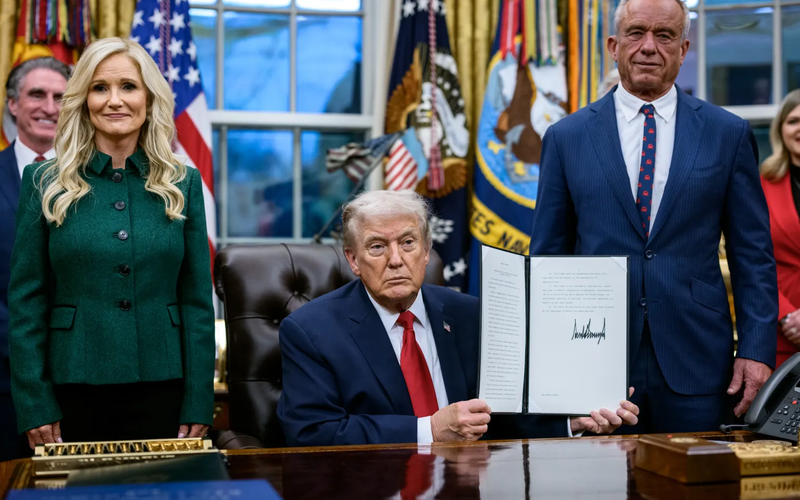
President Donald Trump defended his repeated assertions that his administration has slashed prescription drug prices by 500% to 600% during a White House event, insisting there are 'two ways of calculating' such reductions.
The remarks came as Trump unveiled a deal with Regeneron Pharmaceuticals to lower costs on its drugs as part of the administration's most-favored-nation pricing initiative. Under the agreement, Regeneron will reduce prices on all current and future drugs for Medicaid patients, who often face nominal co-payments. The company will sell its cholesterol medication Praluent for $225 per dose on the TrumpRx website, down from $537. Regeneron also pledged $27 billion for U.S. research, development, and manufacturing, and it will provide its new gene therapy, Otarmeni, free to eligible patients with a rare form of congenital hearing loss.
Trump acknowledged boasting of cuts exceeding 100%, calling them a 'different kind of calculation' that can reach 70%, 80%, or 90% in more conventional terms. 'People understand that better,' he said. 'But they’re two ways of calculating' and 'either way, it doesn’t make any difference.'
Health and Human Services Secretary Robert F. Kennedy Jr. echoed the defense, stating Trump 'has a different way of calculating percentages.' Kennedy cited an example of reducing a $600 drug to $10 as a 600% cut, arguing that prior manufacturer price hikes exceeding 100% justify the framing, as reductions wipe out percentages of costs worth more than 100%.'
The claims drew criticism for being mathematically impossible. Percent reductions cannot exceed 100% without prices dropping below zero, implying manufacturers would pay consumers. For Praluent, the drop from $537 to $225 represents roughly a 58% cut. Sen. Elizabeth Warren questioned Kennedy during a Senate Finance Committee hearing the previous day, noting over-100% cuts would mean 'companies should be paying you to take their drugs.'
Trump's comments fit into broader efforts to curb drug costs. Launched in February, TrumpRx.gov offers discounts on select medications via coupons at participating pharmacies. The MFN policy pressures companies to match lower foreign prices, with tariff relief as an incentive; Regeneron's pact is the 17th and final such deal from outreach last July.
Trump has touted similar large percentage cuts since last year, prompting repeated fact-checks. Proponents highlight tangible savings like those from Regeneron, while detractors focus on the arithmetic dispute.

Comments
No comments yet. Be the first to share your thoughts.