
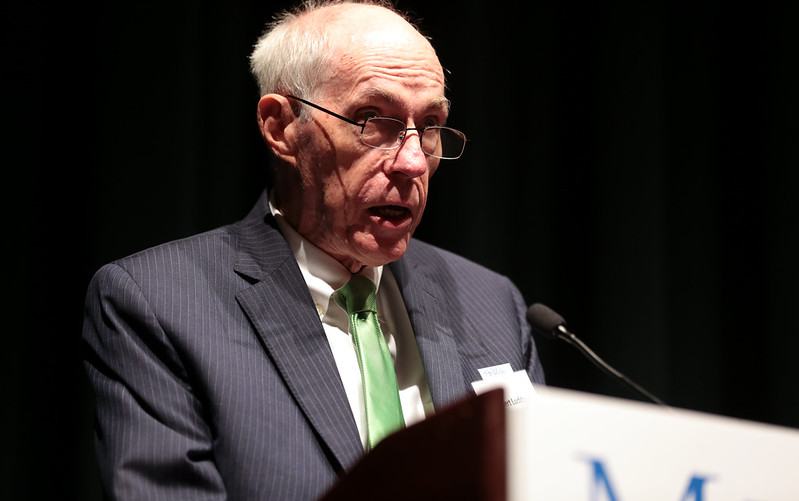
Bob Luddy, founder of CaptiveAire Systems and a major North Carolina Republican donor, has pledged to withhold financial support from any candidate or organization that continues to employ five prominent GOP political consultants, blaming their reliance on negative campaigning and attack ads for the NCGOP’s sweeping 2026 midterm setbacks.
Luddy, who founded one of North Carolina’s largest private companies with annual revenue topping $1 billion and more than 2,000 employees, has donated millions to political campaigns over the past 30 years, according to the National Institute on Money in Politics. He has long backed conservative causes, including lower taxes, school choice, and limited government.
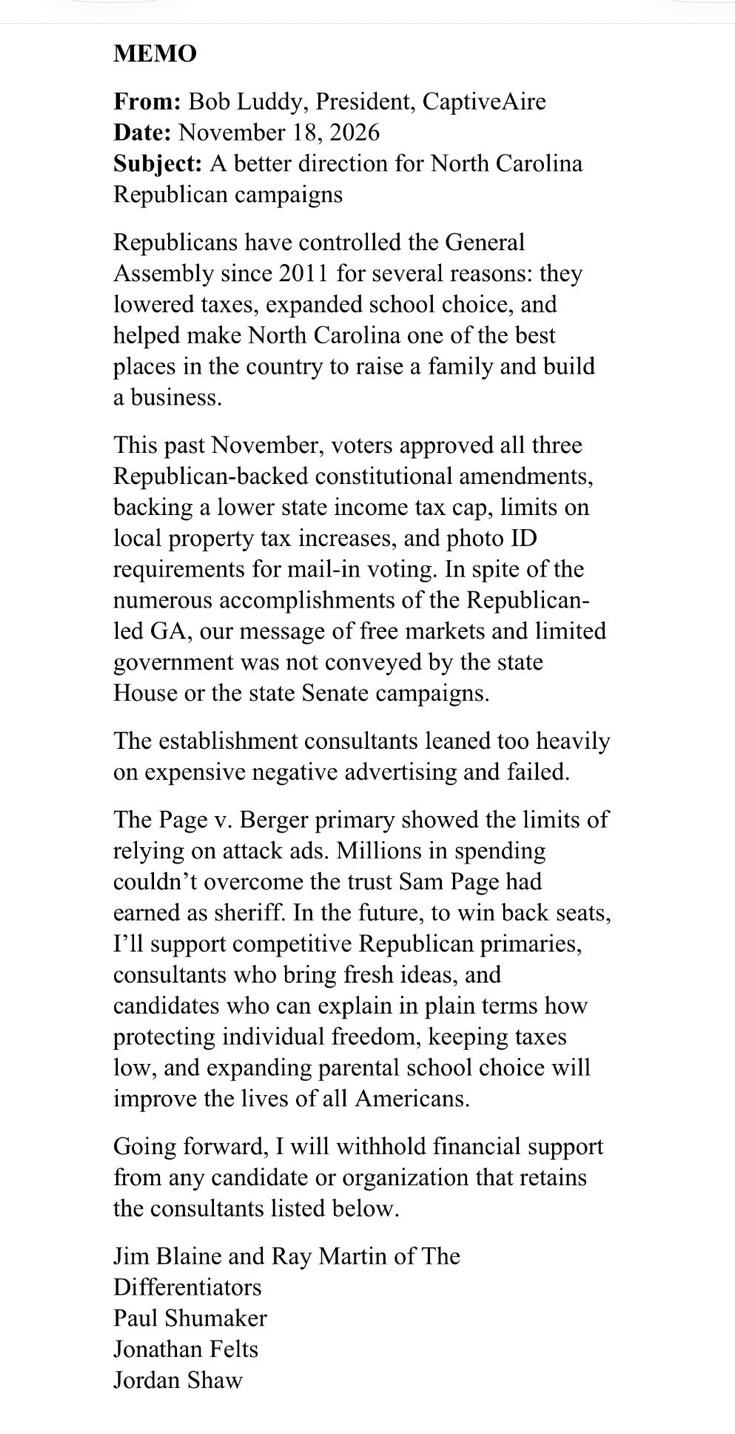
Following Republican losses in the November 3 elections, Luddy sent out a memo that was released on Wednesday. In it, he stated he would withhold support from any candidate or organization that retained consultants Jim Blaine, Ray Martin, Paul Shumaker, Jonathan Felts, and Jordan Shaw.
The five named consultants are long-standing figures in North Carolina Republican campaigns. Jim Blaine and Ray Martin are partners in Differentiators, a consulting and data firm. Furthermore, Blaine previously served as chief of staff to state Senate President Pro Tem Phil Berger from 2011 to 2018 and advised Berger in his March 2026 primary against Rockingham County Sheriff Sam Page. Martin, a former journalist, also worked for Berger. Their firm produced ads and mailers for pro-Berger independent groups such as NC True Conservatives.
Paul Shumaker advised U.S. Senators Richard Burr and Thom Tillis. In 2026 he advised former N.C. House Speaker Tim Moore, who lost his bid for re-election to the U.S. House.
Jonathan Felts has reportedly worked on numerous N.C. races, most prominently Michael Whatley’s unsuccessful U.S. Senate campaign against former Governor Roy Cooper. Whatley lost his bid by nearly 20 points on November 3.
Jordan Shaw managed Thom Tillis’s winning Senate campaigns in 2014 and 2020. In the recent cycle, however, he worked on the unsuccessful congressional campaigns of Greg Murphy, Jennifer Balkcom, and Laurie Buckhout.
These consultants represent much of the established Republican consulting infrastructure in the state. The announcement comes amid broader scrutiny of the state's Republican consulting class following the election results. Conservatives across the state had criticized their role in recent losses before Luddy’s letter circulated.
Luddy's letter signals a push for accountability among operatives tied to recent defeats and the divisive Berger-Page exchanges. Observers note that such donor actions could reshape how candidates select advisers ahead of future cycles.
Luddy credited Republican control of the General Assembly since 2011 with lower taxes, expanded school choice, and making North Carolina “one of the best places in the country to raise a family and build a business.” He also noted that voters approved three Republican-backed constitutional amendments on November 3 (a lower state income tax cap, limits on local property tax increases, and photo ID for mail-in voting).
Despite these outcomes, he argued the broader message failed to land: “our message of free markets and limited government was not conveyed by the state House or the state Senate campaigns. The establishment consultants leaned too heavily on expensive negative advertising and failed.” Democrats flipped control of the N.C. House and won 11 of 14 congressional seats. Republicans had previously held 10.
The Berger–Page primary is a central example. Berger, the longtime Senate leader, faced a narrow primary loss to Sheriff Sam Page in which Berger’s campaign and allied outside groups outraised and outspent Page by far. Reports put total spending supporting Berger’s side at well over $12 million across the cycle, including more than $6–7 million from the independent group NC True Conservatives alone. Much of that went toward attack ads and mailers against Page produced with involvement from Blaine and Martin’s firm.
Luddy and his wife had given the maximum allowable contributions to Page, a sharp shift from years of prior support for Berger. The primary turned heavily negative, with mutual accusations of outside interference and dark-money involvement. Critics of the Berger-side approach, including some involved with Page’s effort, argued the heavy negative advertising backfired among voters who knew Page personally in Rockingham County and that the message never settled on a clear positive case.
Luddy’s stance fits a pattern. In 2015, he publicly withheld a planned $25,000 donation to the House Republican campaign committee over what he viewed as insufficient tax relief and excessive spending in a budget, redirecting the money to Americans for Prosperity-NC instead.
Luddy said he will “support competitive Republican primaries, consultants who bring fresh ideas, and candidates who can explain in plain terms how protecting individual freedom, keeping taxes low, and expanding parental school choice will improve the lives of all Americans.”
His letter, which circulated among North Carolina political circles, marks a direct challenge from a major donor to the state’s Republican consulting establishment after a difficult midterm cycle. Whether it shifts hiring patterns or primary dynamics remains to be seen, but it underscores ongoing tensions between grassroots-oriented conservatives and the professional campaign infrastructure that has dominated much of the party’s recent spending.

Comments
No comments yet. Be the first to share your thoughts.