
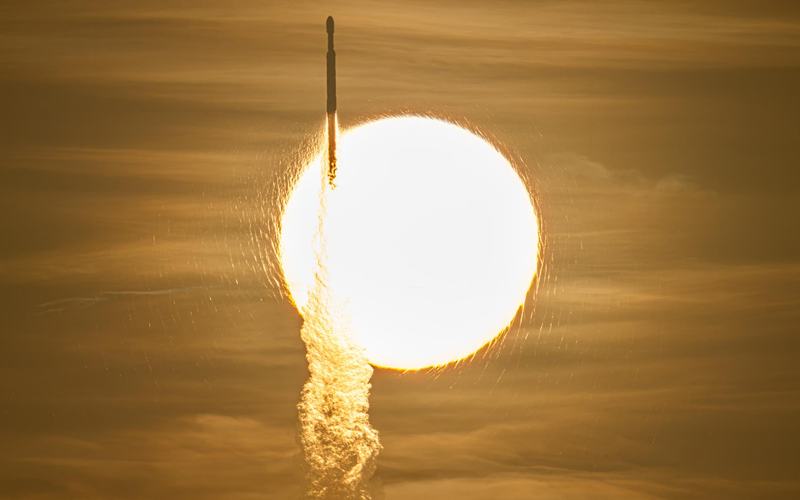
NASA successfully launched its Nancy Grace Roman Space Telescope on Sunday morning from Kennedy Space Center in Florida. The observatory lifted off at 7:26 a.m. EDT aboard a SpaceX Falcon Heavy rocket from Launch Complex 39A.
The telescope is now en route to the Sun-Earth Lagrange Point 2, approximately one million miles from Earth, where it will begin operations after a three-month commissioning period. The mission aims to survey vast areas of the sky to study dark energy, dark matter, exoplanets, and other cosmic phenomena with a field of view 100 times larger than that of the Hubble Space Telescope.
President Trump surprised participants at the post-launch news conference by calling in to congratulate the team. He praised the launch as beautiful and noted the successful performance of the mission. NASA Administrator Jared Isaacman took the call and shared it with attendees.
The $4 billion project represents a major step forward in astrophysics research. Roman carries a 300-megapixel infrared Wide Field Instrument and is expected to deliver its first images in early 2027. The spacecraft will generate 1.4 terabytes of data daily during its primary five-year mission.
Ground teams at NASA's Goddard Space Center received initial telemetry shortly after liftoff, confirming the rocket's performance and the observatory's separation. Solar panels and sun shade deployments occurred as planned in the hours following launch.

Comments
No comments yet. Be the first to share your thoughts.