
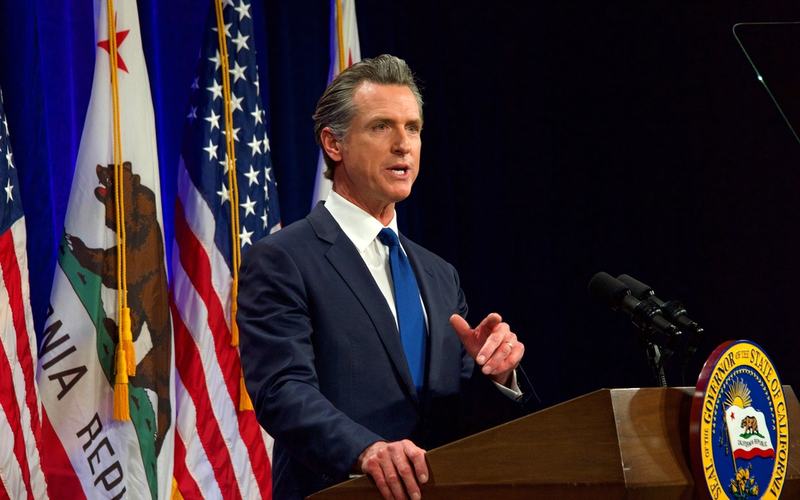
California Gov. Gavin Newsom has developed a nationwide fundraising and organizing operation that could provide a substantial advantage if he enters the 2028 presidential race. His growing contact list has helped him raise millions of dollars for Democratic candidates and state parties, while establishing connections with donors and activists beyond California.
Before California's successful Proposition 50 redistricting campaign last year, Newsom had already amassed more than 17 million email addresses. His advisers say the list has grown significantly since Democrats contributed heavily to the effort to redraw California's congressional maps. They declined to disclose its current size.
Newsom's network has generated more than $6.8 million during the 2026 midterm election cycle through more than 305,000 contributions, with an average donation of $22.47, according to his advisers. The fundraising has largely supported other Democrats rather than Newsom himself.
Of the total, approximately $1.85 million has gone to 15 state Democratic parties, while another $2.2 million has supported Southern Democrats seeking to strengthen their political infrastructure. The investments target states where Democrats have struggled to compete and where the party hopes to expand its reach.
The operation could become a significant resource if Newsom pursues the presidency, providing him with both a national donor base and an established system for reaching potential supporters. Garry South, a longtime Newsom adviser, said the governor would benefit from California's large pool of donors as well as the national connections developed through the Proposition 50 campaign.
Newsom began building his email list in 2021, when he faced a recall effort and had approximately 250,000 contacts. By 2022, the list had grown to 6 million. He subsequently hired Tim Tagaris, who helped manage Sen. Bernie Sanders' digital operation during the 2016 presidential campaign, to expand the governor's fundraising and outreach capabilities.
Newsom has used the network to mobilize supporters around political disputes with President Donald Trump and Republicans, as well as to finance Democratic campaigns. During the 2024 election cycle, he contributed more than $21 million to Democratic candidates and political efforts through his fundraising operation.
Other potential Democratic presidential contenders have also developed substantial small-dollar fundraising operations. Rep. Alexandria Ocasio-Cortez of New York raised more than $37 million during the current election cycle, much of it through donations of $200 or less. Her campaign reported more than $17 million in cash on hand at the end of September as she considers a potential presidential bid or a campaign for the U.S. Senate.
Democratic strategist Christy Setzer said small-dollar donations can demonstrate a candidate's political strength and momentum, although fundraising totals alone do not determine election outcomes. Such contributions can also help candidates establish name recognition without relying exclusively on wealthy donors and super PACs.
Newsom's operation has directed money and volunteers toward several states that could become important in the 2028 Democratic primary process. In August, he solicited donations for former Rep. David Jolly in Florida and South Carolina gubernatorial candidate Jermaine Johnson, arguing that Democrats had neglected Southern states and needed to invest in long-term organizing.
In New Hampshire, Newsom's network raised more than $579,000 for Democrats during the current cycle. Some of that money helped establish a new Democratic field office in Nashua and support state-level candidates.
South Carolina, which is scheduled to hold the first Democratic presidential primary in 2028, has also received substantial support. Newsom's team said his network raised more than $342,000 for the state Democratic Party, $53,000 for Johnson's gubernatorial campaign and more than $61,000 for six state House candidates.
The funding has helped smaller campaigns cover expenses that would otherwise be difficult to meet. Newsom's team said some legislative candidates received approximately $10,000 apiece, an amount that can represent an entire campaign budget for candidates with limited fundraising resources.
In Nevada, Newsom used his network to raise money, recruit volunteers, and support organizing efforts. During an appearance with Nevada Attorney General Aaron Ford, a gubernatorial candidate, and Rep. Steven Horsford, his team used the contact list to rally supporters and help open a new field office.
Back in California, Newsom directed another $500,000 toward five congressional candidates running in districts made more competitive by Proposition 50's redistricting changes.
Despite the nationwide fundraising effort, Newsom has not announced whether he will seek the Democratic presidential nomination in 2028. His office maintains that his current priority is helping Democrats win the midterm elections.
Newsom spokesperson Izzy Gardon said the governor is using his time, resources, and national small-donor network to support candidates and political parties, particularly in down-ballot races that receive less national attention. The network, however, has already established a fundraising and organizing infrastructure that could be put to use if he decides to launch a presidential campaign.

Comments
No comments yet. Be the first to share your thoughts.