
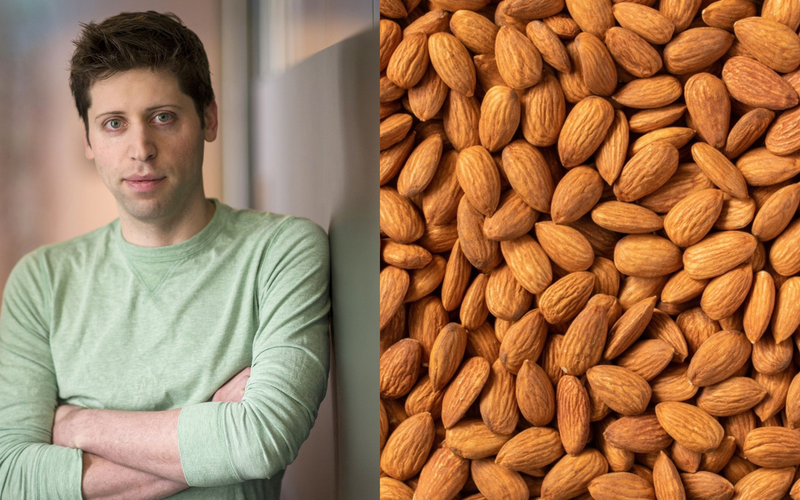
OpenAI CEO Sam Altman said that producing one California almond requires about as much water as it takes to run 38,000 ChatGPT queries, sparking debate about which is a better use of resources.
Altman made the remark during the debut episode of the Sources podcast with journalist Alex Heath. He pushed back against viral claims that a single AI query consumes water equivalent to running a shower for hours, calling such narratives a persistent meme that does not hold up under scrutiny.
Modern large data centers, Altman added, use roughly the same amount of water as a typical office building for sinks, toilets, and other routine needs. He noted that older evaporative cooling systems have largely been replaced in newer facilities.
The comparison drew immediate attention to the math behind water estimates. A 2019 study linked to U.S. Geological Survey researchers found that growing one California almond requires an average of 3.56 liters of water. Altman has previously stated that a typical ChatGPT query uses about 0.32 milliliters of water.
Dividing those figures yields roughly 11,000 queries per almond rather than 38,000.
Altman acknowledged he was citing the number from memory and said the broader point still stands. Other estimates place almond water use between 1.1 and 12 liters per nut depending on the methodology and location.
Critics of Altman have pointed out that data center consumption is not in a vacuum. Shaolei Ren, a professor of electrical and computer engineering at UC Riverside, noted that on hot days, when data centers require the most cooling, peak water demand can substantially increase.
“For community water systems, the peak capacity is more important because they need to be designed and built to accommodate the peak demand at all times, similar to our power grid,” Ren said.
Ren’s team found that data center cooling systems could call for 697 to 1.45 billion more gallons of peak water capacity per day. It’s comparable to New York City’s average daily supply, the study says. And unlike irrigation water typically used for farms, water for data centers is often treated, potable water from public water systems, the team reported.
Public data on data center water consumption remains limited, making precise comparisons difficult.
However, A study conducted by the Florida Water & Pollution Control Operators Association notes that one large facility can use as much water as a small city, adding that the water is not used as a raw material but rather to keep servers cool. Importantly, the water doesn't cease to exist after its use. Oftentimes, water used by data centers returns to the water supply quite easily.
Several means can be used to maintain data center cooling, which the study states include: Air cooling, evaporative cooling, closed-loop water cooling, direct liquid cooling and immersion, and free cooling.
While there are several means of cooling servers, water cooling is the most common method in data centers worldwide, accounting for roughly 75-90% of installations, according to the study.
To counter criticism, leading AI companies have announced initiatives to reduce the environmental impact of data centers.
An example includes the use of Battery Energy Storage Systems, or BESS, which are essentially large batteries that store electricity when it’s available and release it when it’s needed. This makes them ideal for data centers, which require a constant, reliable power supply.
Utilizing lithium-ion batteries, the same type found in smartphones and electric cars, BESS can react almost instantly, much faster than diesel generators, helping data centers stay online without interruption, while producing no emissions when in use.
While California almond production alone consumes trillions of gallons of water each year, data centers have been the target of far more criticism for their water use.
Altman said changing public perception on the issue remains challenging but necessary for the industry.

Comments
No comments yet. Be the first to share your thoughts.