
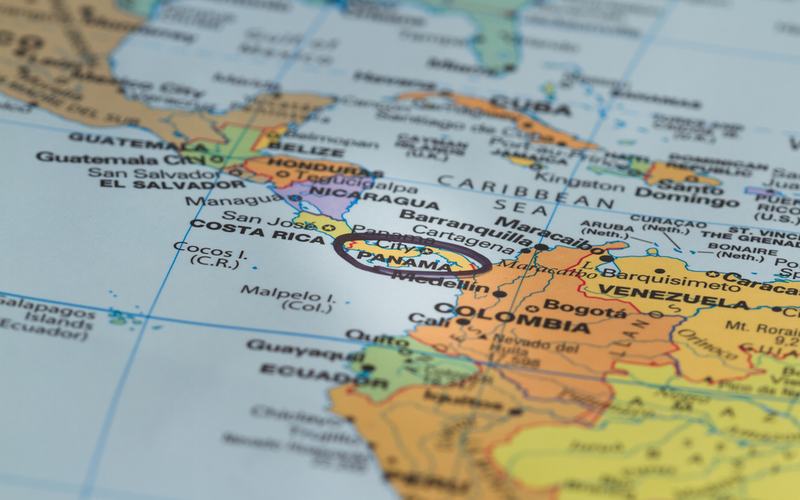
Panama declared a state of emergency Saturday after two powerful earthquakes struck the Central American country, damaging homes, schools, hospitals, roads and historic buildings across all 10 provinces and two Indigenous territories. Officials reported dozens of injuries, but no confirmed deaths, as communities continued to experience aftershocks and some areas remained difficult to reach.
The earthquakes, measuring magnitudes 7.7 and 6.6, struck Friday and toppled buildings near the epicenter while prompting evacuations across the country. Seismologists subsequently recorded more than 100 aftershocks, including tremors measuring magnitudes 5.8, 5.5 and 5.2.
The first major earthquake was centered approximately 10 kilometers, or six miles, southwest of Pitaloza Arriba, a remote community in the central province of Herrera, according to the U.S. Geological Survey. It struck at a depth of approximately six miles and was also felt in neighboring Colombia.
Presidential Minister Juan Carlos Orillac announced the emergency during a news conference in Panama City, citing widespread damage to residential and public infrastructure. Malitzie Rivera, deputy director of Panama's National Civil Protection System, said authorities had received reports of 27 injuries ranging from minor to moderate.
The hardest-hit areas included the central provinces of Veraguas, Herrera, Coclé and Los Santos. Civil Protection officials estimated that approximately 420 homes and a similar number of public schools had sustained damage. Seven hotels, at least 13 churches and nine bridges were also affected.
In La Villa de Los Santos, a historic community roughly 40 miles northeast of the epicenter, homes and a colonial-era Catholic church collapsed. The Church of San Atanasio, which was designated a National Historic Heritage Site in 1938, was among the damaged landmarks.
Residents spent the night outdoors as they awaited further instructions from authorities. Tony Jiménez, 90, whose home partially collapsed, described the experience while sitting with relatives beneath a tent.
“We’ve been here since 1 p.m. yesterday; we haven’t moved,” Jiménez said. “It was a terrible thing. I can tell you with absolute certainty that in my 90 years, I had never experienced anything like it.”
Despite the extensive destruction, officials had not reported any missing people as of Saturday. However, landslides and damaged roads had cut off access to some communities, complicating efforts to assess the full extent of the damage and deliver assistance.
Authorities also evacuated approximately 300 people from Isla Caña, off the Pacific coast of Los Santos, because of rising sea levels and rough surf. In Penonomé, about 93 miles from Panama City, a shelter housed 13 people, including five children. The earthquakes caused partial structural damage and cracks at the local cathedral, as well as damage to the governor's office and the Dos Continentes hotel.
Infrastructure disruptions extended to the capital. One water treatment plant supplying Panama City was operating at just 20% capacity Saturday, while temporary facilities equipped with cots were established at six hospitals.
Tocumen International Airport, one of Latin America's busiest aviation hubs, temporarily suspended operations after the first earthquake before reopening hours later Friday. The disruption nevertheless left travelers stranded at airports throughout the region as connections through Panama were canceled or delayed. Copa Airlines passengers were among those affected by the interruptions to the country's extensive air-travel network.
The Panama Canal Authority said canal operations continued normally, preserving the flow of international maritime traffic through one of the world's most important trade routes. The agency said employee, vessel and crew safety remained its priority while specialized technical teams inspected facilities for possible earthquake damage.
The U.S. government announced assistance Saturday as Panama began responding to the disaster. The State Department said it had mobilized a disaster response team to support local authorities with search-and-rescue expertise and aerial and ground assessments. Washington also pledged $5 million in humanitarian assistance.
U.S. Southern Command separately reported that two helicopters, supported by the State Department's drug-control bureau, had delivered 2,000 pounds of food to affected Panamanian communities.
The disaster comes as parts of Latin America have faced other major earthquakes in recent months. Panama's comparatively limited reported casualty toll prompted Carlos Valdés, head of the Seismology Department at Mexico's National Autonomous University, to suggest that the country's building regulations may have helped reduce fatalities, particularly in the capital, where skyscraper construction is subject to strict standards.
Panama's last major earthquake to cause widespread damage occurred in 1991, when a magnitude 7.4 earthquake centered in neighboring Costa Rica killed 23 people, injured 559, and left thousands homeless in Panama's Bocas del Toro border region.
The country remains vulnerable to seismic activity because it lies along the Pacific Ring of Fire, a roughly 25,000-mile arc of volcanoes and fault lines where much of the world's earthquake activity occurs. The interaction of the Cocos, Nazca and Caribbean tectonic plates contributes to seismic risks along Panama's Pacific coast and its border with Costa Rica.
Regional leaders expressed support following Friday's earthquakes, and Panamanian officials said President José Raúl Mulino had spoken with leaders from several Latin American countries about the emergency.
As aftershocks continued and damage assessments expanded, authorities faced the task of restoring essential services, reaching isolated communities and determining how many residents would need temporary shelter. The state of emergency is intended to support the government's response as the country begins recovering from the widespread damage.

Comments
No comments yet. Be the first to share your thoughts.