
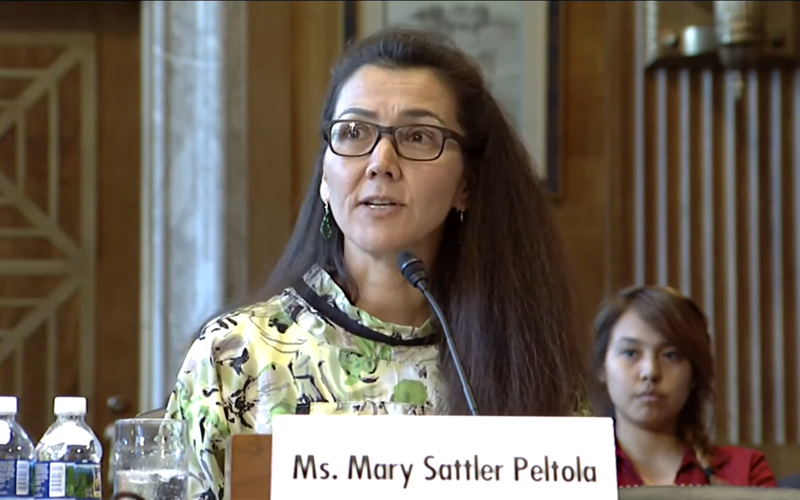
With unofficial results showing Democrat Mary Peltola holding a commanding lead of more than 11,000 first-choice votes and hovering near or just under the 50 percent threshold in Alaska’s ranked-choice Senate race, multiple projections now point to her unseating Republican incumbent Dan Sullivan. The outcome, if certified, would hand Democrats a notable pickup in a state President Trump carried by double digits. Yet the projected victory arrives under a cloud of federal and state investigations into an alleged effort by people tied to her campaign to place a second candidate named Dan Sullivan on the ballot specifically to confuse voters.
The controversy centers on Daniel J. Sullivan Jr., a retired teacher from the remote Southeast Alaska community of Petersburg. Listed on the general election ballot as “Sullivan, Daniel J. Jr.” with no party affiliation, he finished with roughly 1.7 percent of the first-choice vote. Critics have long labeled him “Decoy Dan,” arguing his presence was engineered to siphon support from the real Senator Dan S. Sullivan, who appears on the ballot as the registered Republican incumbent.
A late-October New York Times investigation, based on interviews with roughly a dozen people, text messages, and documents, reported that operatives connected to Peltola’s campaign and senior aides at the Democratic Senatorial Campaign Committee had spent months identifying and recruiting Alaskans named Dan Sullivan. According to the Times, a Peltola staffer was directed in the summer of 2025 to comb voter rolls for potential namesakes. An operative allegedly traveled the state under a false name, making pitches over beers in brew pubs. The effort also reportedly included outreach to other potential spoilers, such as drywall contractor Gerald Heikes. The Times’s account said Peltola herself was not directly running the project but was “definitely aware,” according to her former campaign manager Elisa Rios (who later sought to retract her statements before publication).
Peltola has repeatedly and categorically denied any knowledge. At a Juneau event she stated she “knew nothing about any other candidate on the ballot except for me and the incumbent” and insisted she was “not interested in tricking voters.” Her campaign and the DSCC issued similar denials, describing the reporting as a distraction. Republicans, including Sen. Sullivan, have called those denials false. Trump has labeled the arrangement election fraud and demanded legal consequences for Peltola and the second Sullivan.
Alaska election officials had earlier concluded that Daniel J. Sullivan’s candidacy was not filed in good faith and was intended to confuse or mislead, and they sought to remove him. State courts, including the Alaska Supreme Court, ultimately allowed him to remain on the ballot. A separate federal lawsuit filed by the Justice Department seeking to block certification of the results if the second Sullivan’s votes could have changed the outcome was dismissed by a judge, who found the government lacked a workable remedy that would not violate ballot secrecy. That dismissal has not ended the parallel criminal inquiry.
The Justice Department escalated its probe after the Times report, issuing dozens of grand jury subpoenas and records-preservation demands. Target letters have gone out to people aligned with the Democratic effort, including figures at the Elias Law Group, which has represented both Peltola’s campaign and the DSCC. Alaska Governor Mike Dunleavy separately ordered a state investigation into whether criminal charges are warranted under Alaska law. No one has been charged, and the investigations remain ongoing as the final absentee ballots are processed and ranked-choice tabulation is scheduled.
Even as Peltola’s first-choice total approaches or exceeds half the vote—with analyses of cast-vote records suggesting she would also prevail in a ranked-choice runoff—the dual-Sullivan ballot and the documented recruitment effort continue to fuel questions about whether the race was distorted by deliberate voter confusion. For a candidate on the verge of becoming Alaska’s next U.S. senator, the immediate political victory may prove only the opening chapter of a longer legal process.

Comments
No comments yet. Be the first to share your thoughts.