

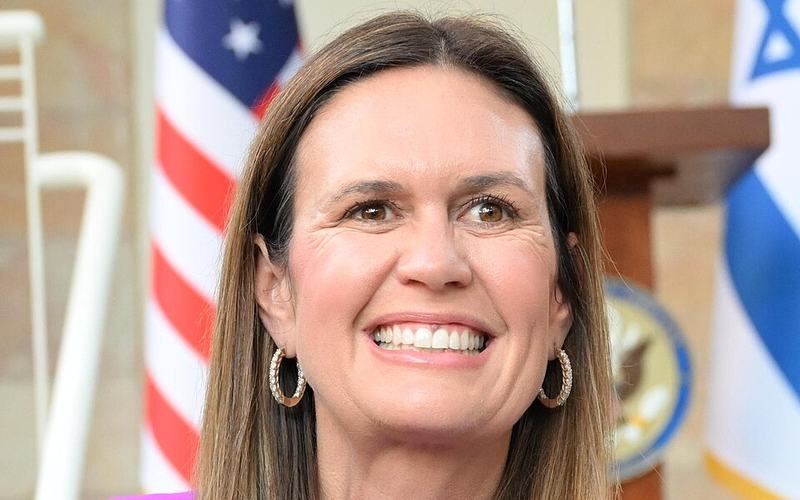
Republican Gov. Sarah Huckabee Sanders defeated Democratic state Sen. Fred Love in Arkansas’ gubernatorial election, winning a second term and extending her leadership of the state through 2031. Sanders’ victory continues Republican control of the governor’s office and gives the former White House press secretary another four years to advance her conservative agenda.
Sanders made history in 2022 when she became the first woman elected governor of Arkansas, defeating Democrat Chris Jones with approximately 63% of the vote. Before returning to Arkansas, she served as White House press secretary during President Donald Trump’s first administration from 2017 to 2019, becoming one of his most recognizable public defenders. She is also the daughter of former Arkansas Gov. Mike Huckabee, who ran for president in 2008 and 2016.
During her first term, Sanders made education reform, tax reductions, public safety and government efficiency central priorities. Her signature legislative achievement was the Arkansas LEARNS Act, a sweeping education law that increased minimum teacher salaries, expanded school choice, and established a system of education freedom accounts to help eligible families pay for private school tuition and other educational expenses.
Sanders argued that parents should have greater control over their children's education and that students should not be limited to schools based on their ZIP code. The program became one of the most prominent examples of Republican school choice legislation in the country, while Democrats and public education advocates criticized its use of public funds for private education.
Her administration also pursued tax cuts, including reductions to individual and corporate income tax rates, while backing tougher criminal penalties and additional prison capacity. Sanders defended those policies as part of an effort to make Arkansas more competitive economically, strengthen public safety and give families greater control over their futures.
Love, a Democratic state senator from Little Rock, campaigned on a different set of priorities, focusing on public education, health care, economic development and the cost of living. He repeatedly criticized the governor's school voucher program and promised to halt its expansion if elected. Love argued that Arkansas should prioritize strengthening public schools rather than directing taxpayer money toward private school tuition.
The candidates also disagreed over the state's budget priorities, health care and the cost of gasoline. Love called for suspending the state gasoline tax amid rising fuel prices and argued that Sanders had focused on political priorities rather than the everyday concerns of Arkansas families. He also criticized the governor's proposed prison expansion and questioned whether her administration had adequately addressed the needs of rural communities.
Sanders defended her record by pointing to tax cuts, education reforms and efforts to expand economic opportunities. Her campaign argued that the state was moving in the right direction and that another term would allow her administration to implement the policies passed during her first four years. She also emphasized her close relationship with Trump and support for his broader political agenda.
The governor entered the general election with a substantial financial and political advantage. Her campaign had raised millions of dollars, while Love faced a much smaller fundraising operation. An October Hendrix College and Talk Business & Politics poll of 709 likely voters found Sanders leading Love 51% to 32%, with Libertarian candidate Colt Shelby receiving 11%. The survey had a margin of error of plus or minus five percentage points.
Beyond Arkansas, Sanders' reelection is likely to renew speculation about her political future. With the 2028 presidential election approaching, her experience as Trump's press secretary, her relationship with the president, and her position as a conservative Republican governor have made her a potential name in discussions about the next GOP presidential ticket.
Sanders has acknowledged that running for president has crossed her mind, although she has not announced any plans to seek the nomination. She has also been mentioned as a possible vice presidential contender, particularly as Republicans begin considering who could carry the party's message into the next presidential election. For now, Sanders has said her focus remains on governing Arkansas and completing the work of her second term.
Her reelection gives her additional time to build a national political profile before the 2028 election cycle. Her father, Mike Huckabee, previously sought the Republican presidential nomination, winning the Iowa caucuses in 2008, giving the family an established history in national Republican politics.
For Arkansas Republicans, Sanders' victory preserves the party's control of the governor's office and allows her administration to continue pursuing its education, tax, and public safety priorities. For Democrats, Love's defeat represents another unsuccessful attempt to break the Republican hold on the state's highest office.
Sanders will begin her second term in January 2027, with education policy, tax relief, public safety and economic development expected to remain central to her agenda. Whether she eventually pursues a national campaign or becomes part of a Republican presidential ticket remains to be seen, but her reelection keeps her in a position to remain a prominent figure in the party's future.

Comments
No comments yet. Be the first to share your thoughts.